




FIR vs IIR Filters
FIR and IIR are the two families of digital filter used in audio processing, including monitor and room correction. An IIR filter is recursive and efficient, behaves like an analog filter, adds little latency, and imposes phase shift along with its magnitude changes. An FIR filter is non-recursive, is always stable, and can have exactly linear phase, meaning it can change magnitude without rotating phase, but it needs many coefficients for low-frequency resolution and so adds latency and can cause pre-ringing. Neither is better in general. IIR suits low-latency, minimum-phase tasks, while FIR suits linear-phase correction and crossover work where the added latency is acceptable.
What FIR and IIR Mean
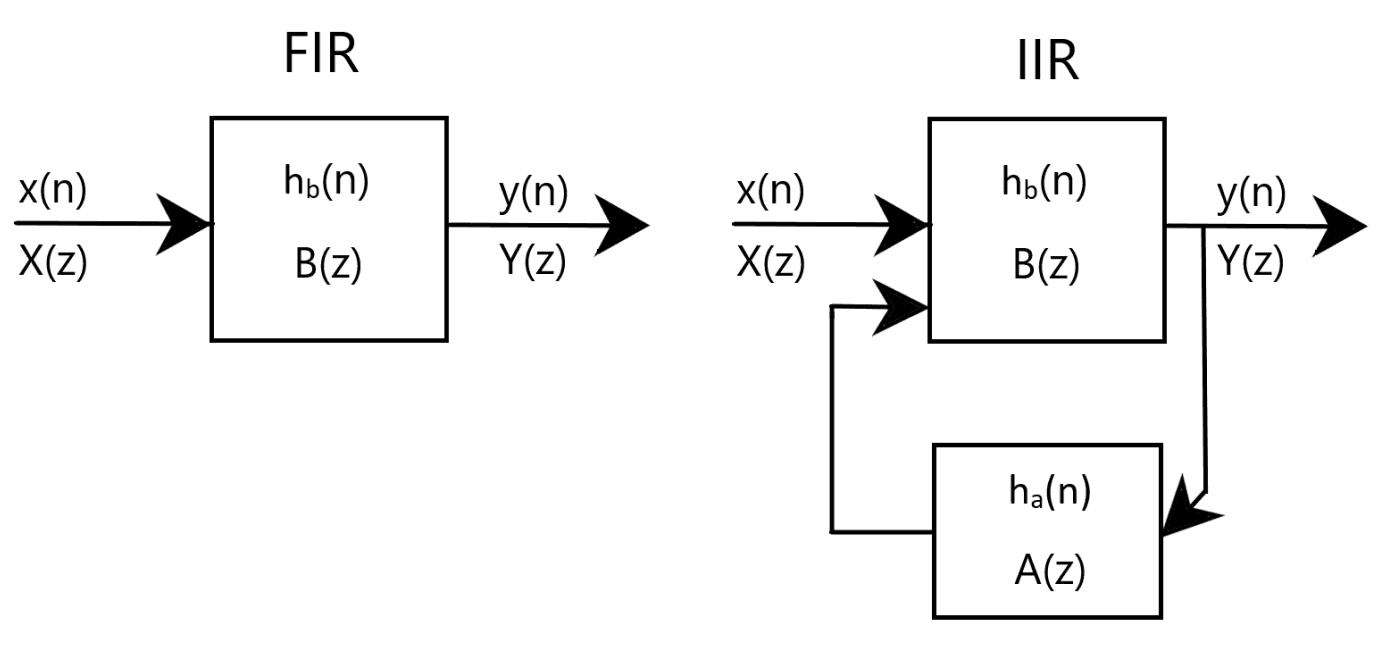
Both are digital filters, which means they change a signal's frequency content by combining samples. The difference is whether the filter feeds its own output back into itself.
- IIR filter (infinite impulse response)
- A recursive digital filter whose output depends on past outputs as well as past inputs. It is efficient, behaves like an analog filter, and its response in theory continues indefinitely.
- FIR filter (finite impulse response)
- A non-recursive digital filter whose output depends only on a finite number of past input samples, called taps. It is always stable and can be designed for exactly linear phase.
Because an IIR filter uses feedback, it can achieve a strong response with very few coefficients, which is why it is efficient and is the digital equivalent of classic analog filter shapes. An FIR filter uses only a finite list of input coefficients, so it cannot run away or become unstable, and its symmetry can be chosen to give linear phase.
How They Differ
The two families trade efficiency and latency against phase control.
| IIR | FIR | |
|---|---|---|
| Structure | Recursive (uses feedback) | Non-recursive (taps only) |
| Efficiency | High, few coefficients | Lower, many taps for low frequencies |
| Latency | Low | Higher (grows with tap count) |
| Phase | Minimum-phase, rotates phase | Can be exactly linear phase |
| Stability | Can be unstable if poorly designed | Always stable |
| Pre-ringing | None | Possible with linear phase |
| Analog equivalent | Yes (Butterworth and similar) | No direct analog equivalent |
The key trade is phase against latency. An IIR filter changes phase along with magnitude, like an analog filter, and adds almost no delay. A linear-phase FIR can change magnitude while leaving phase untouched, but it needs enough taps to resolve low frequencies, and that length both adds latency and can produce pre-ringing, which is energy appearing before a transient.
Which to Use in Monitoring
In monitor and room correction, both have clear roles. Most room and driver anomalies are minimum-phase, which means correcting their magnitude also corrects their phase, so an efficient, low-latency IIR filter is a natural fit and is what much onboard correction uses. IIR is also preferred when latency matters, such as while tracking or performing.
FIR is used where linear phase is specifically wanted, such as flattening the through-system phase, linearising a crossover, or applying a phase correction an IIR cannot. The cost is delay, which is acceptable for mixing or mastering playback but a problem for live monitoring. The more fundamental cost is pre-ringing. A linear-phase FIR has a symmetric impulse response, so it spreads energy ahead of a transient, and that pre-ring is inherent to linear phase rather than a design mistake. It can be reduced or moved in frequency, but not removed, and on percussive material it can soften the attack and smear the transient.
Tantrum's position: fix coherence in the physics
We treat linear-phase FIR correction as a last resort for transient-critical monitoring, because its pre-ringing cannot be eliminated, only traded. We prefer to solve coherence at the source, with a single or coincident driver, sensible crossover behaviour and time alignment, so the wavefront is coherent to begin with and there is nothing to correct after the fact. Physics that avoids the artefact is more dependable than DSP that trades it.
The phase-coherence guide covers how these choices relate to minimum-phase and linear-phase correction in practice.
Common Misconceptions
FIR filters are always better than IIR.
They solve different problems. FIR offers linear phase and guaranteed stability, but at higher latency and CPU cost and with possible pre-ringing. IIR is efficient and low-latency and matches minimum-phase anomalies. Neither is universally better.
Linear phase always sounds more accurate.
Linear phase flattens phase, but it adds latency and produces pre-ringing that is inherent to it and can soften and smear transients. For minimum-phase room and driver anomalies, minimum-phase correction is often the better match, and solving coherence in the speaker's physics avoids the artefact altogether.
More taps always make a better FIR filter.
More taps add latency and CPU cost. You need enough taps to resolve the lowest frequency you are correcting, and beyond that the extra length buys delay rather than accuracy.
An IIR filter is just a digital copy of an analog filter.
IIR filters mirror analog shapes and minimum-phase behaviour, but digital design adds its own considerations, including coefficient precision and stability, that have no analog equivalent.
Frequently Asked Questions
What is the difference between FIR and IIR filters?
An IIR filter is recursive, using feedback, so it is efficient and low-latency and behaves like an analog filter, rotating phase as it changes magnitude. An FIR filter is non-recursive, always stable, and can have exactly linear phase, but it needs many taps for low frequencies, which adds latency.
What does linear phase mean?
A linear-phase filter delays all frequencies by the same amount, so it can change magnitude without rotating phase relative to the signal. FIR filters can be designed this way; standard IIR filters cannot. The trade is added latency and possible pre-ringing.
Why do FIR filters add latency?
An FIR filter sums a finite list of input samples, and resolving low frequencies needs many of them. A linear-phase FIR is symmetric, so its delay is about half its length, which grows as you add taps to reach lower frequencies.
What is pre-ringing?
Energy that appears before a transient, a side effect of linear-phase FIR filters because their symmetric impulse response spreads energy ahead of the main peak. The ear finds it unnatural, so linear-phase filters should be designed to keep it low.
Are IIR filters unstable?
They can be if poorly designed, because their feedback can run away. Well-designed IIR filters are stable. FIR filters are always stable by construction, since they have no feedback, which is one of their advantages.
Which is more CPU efficient?
IIR, usually by a wide margin, because feedback lets it achieve a strong response with very few coefficients. FIR filters need many taps for the same low-frequency resolution, though techniques like fast convolution reduce the cost.
Which is better for room correction?
Both are used. Most room and driver anomalies are minimum-phase, so an efficient, low-latency IIR filter corrects them well, and much onboard correction is IIR. FIR is used where linear phase or crossover linearisation is specifically wanted, accepting the added latency.
Why does latency matter for monitoring?
Delay between input and output is disruptive when tracking or performing, where you need to hear yourself in time. Low-latency IIR is preferred there. FIR's higher latency is acceptable for mixing or mastering playback, where real-time feel is less critical.
Can an IIR filter be linear phase?
Not in the normal sense. Standard IIR filters rotate phase along with magnitude. There are offline tricks to achieve linear-phase results, but real-time IIR filtering is minimum-phase, which is why FIR is used when linear phase is required.
How does this relate to phase coherence?
Filter choice is one way phase coherence is managed in a monitor. IIR matches minimum-phase anomalies efficiently, while linear-phase FIR can flatten through-system phase at the cost of latency and pre-ringing. The phase-coherence guide covers the audible side of these choices.
Conclusion
FIR and IIR are complementary tools, not competitors. IIR filters are efficient, low-latency and minimum-phase, which matches most room and driver anomalies and suits real-time monitoring. FIR filters are always stable and can be exactly linear phase, which is valuable for flattening phase or linearising a crossover, at the cost of latency and possible pre-ringing. Choose IIR when efficiency and low latency matter and the anomaly is minimum-phase, and FIR when linear phase is the goal and the delay is acceptable. Where transient integrity matters most, resolving coherence in the physical design, rather than with a linear-phase FIR whose pre-ringing cannot be removed, is the more dependable route.
Glossary
- IIR filter
- A recursive digital filter, efficient and low-latency, behaving like an analog filter and rotating phase.
- FIR filter
- A non-recursive digital filter using a finite set of taps, always stable and able to be linear phase.
- Taps
- The input coefficients of an FIR filter; more taps give lower-frequency resolution but more latency.
- Linear phase
- Equal delay for all frequencies, so magnitude can change without rotating phase.
- Pre-ringing
- Energy appearing before a transient, a side effect of linear-phase FIR filters.
Sign up to hear more when we release something new


