




Why Small Rooms Cause Bass Problems
Small rooms cause bass problems because low-frequency sound has wavelengths comparable to, or larger than, the room's dimensions. At those frequencies the room stops behaving like open space and starts resonating. Standing waves (room modes) build up between parallel surfaces, creating peaks where bass is exaggerated and nulls where it almost disappears, with the effect changing dramatically from one seat to the next. Reflections from nearby boundaries also cancel parts of the low end (SBIR). The smaller the room, the higher in frequency these problems reach and the more widely spaced and audible the individual modes become, and that is why bass is the hardest thing to get right in a small studio.
Wavelength vs Room Size
Sound travels at roughly 343 metres per second, so a frequency's wavelength is that speed divided by the frequency. A 50 Hz bass note has a wavelength of nearly 7 metres, and a 100 Hz note is about 3.4 metres. Those lengths are similar to, or bigger than, the dimensions of a typical small studio. When a wavelength is comparable to a room dimension, the room no longer behaves like free space. It behaves like a resonant cavity, reinforcing some frequencies and cancelling others.
- Wavelength
- The physical length of one cycle of a sound wave, equal to the speed of sound divided by the frequency. Low frequencies have long wavelengths, high frequencies have short ones.
By contrast, high frequencies have wavelengths of just centimetres, far smaller than the room, so treble behaves more like rays of light. It reflects and absorbs predictably and doesn't set up large-scale resonances. This is why small-room problems are overwhelmingly a low-frequency phenomenon, and why the midrange and treble are comparatively easy to get right.
Room Modes and Standing Waves
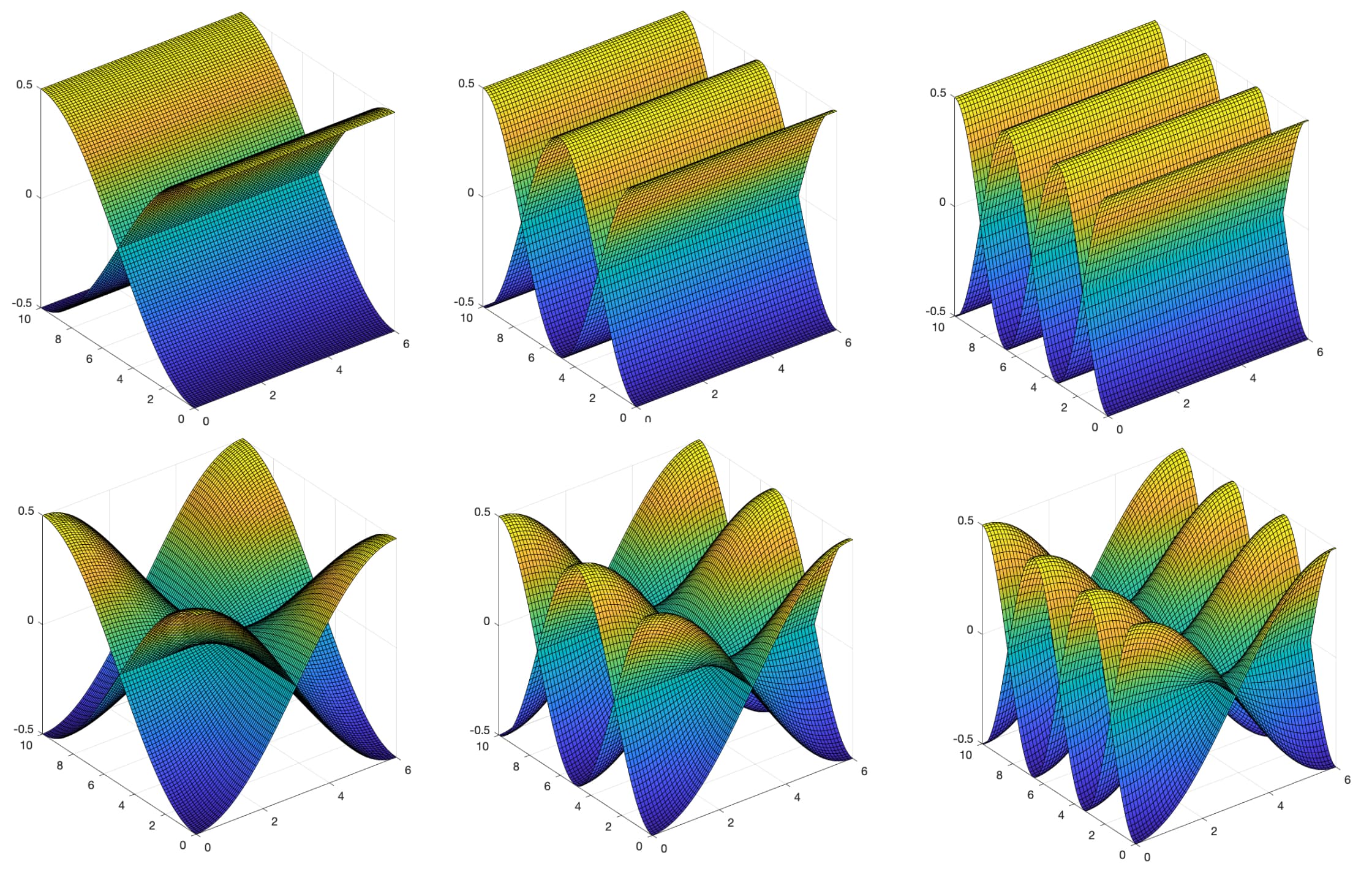
When sound reflects back and forth between two parallel surfaces, certain frequencies reinforce themselves. The reflected wave lines up with the outgoing wave and they add together into a standing wave, or room mode. At a mode's frequency the room sustains a stable pattern of pressure peaks (antinodes) and pressure minima (nodes) fixed in space.
- Room mode (standing wave)
- A resonance of the room at a frequency where reflections between surfaces reinforce, producing fixed regions of high pressure (peaks) and low pressure (nulls). The lowest axial mode of a dimension L is roughly 343 ÷ (2 × L) hertz.
The lowest mode along a dimension occurs where half a wavelength fits the distance. For a 3-metre wall spacing that's about 57 Hz, with further modes at multiples above it. Because the peaks and nulls are fixed in space, the bass you hear depends entirely on where you sit. At a pressure peak a note booms, and a metre away at a null the same note can almost vanish. This position dependence is what makes small-room bass so frustrating, and why moving the speakers or the seat changes everything.
Suggested diagram: pressure distribution of the first axial mode
Top-down room plan showing the first length-mode, with pressure maxima (red) at both end walls and a pressure null (blue) through the centre of the room. Mark a listening position at the null labelled 'bass sounds thin here' and one near the wall labelled 'bass booms here'. A small inset shows the half-wavelength fitting between the walls.
- Node and antinode
- A node is a location where the standing-wave pressure is at a minimum (the frequency sounds weak there). An antinode is where pressure is at a maximum (the frequency sounds strong). Their positions are fixed by the room and the frequency.
Axial, tangential and oblique modes
Axial modes involve two parallel surfaces and are the strongest. Tangential modes involve four surfaces and are weaker, and oblique modes involve all six and are weaker still. Axial modes do most of the audible damage in small rooms.
Boundary Cancellation (SBIR)
Modes aren't the only problem. A second effect comes from the reflection off the boundary immediately behind or beside a speaker. The direct sound and the reflected sound travel slightly different distances to your ears, and at the frequency where that path difference equals half a wavelength they arrive out of phase and cancel, carving a dip into the low end. This is the speaker-boundary interference response, or SBIR.
- SBIR (speaker-boundary interference response)
- Comb-filter-like reinforcement and cancellation in the low end caused by the interference between a speaker's direct sound and its reflection from a nearby boundary (front wall, side wall or floor). The cancellation frequency depends on the speaker's distance from that boundary.
Because the cancellation frequency depends on distance to the boundary, the position of both the speakers and the listener relative to the walls directly shapes the low-frequency response. In a small room there's little freedom to move things far from boundaries, so SBIR dips often land squarely in the musically important bass region. SBIR and room modes together explain why two nearby positions can measure completely differently in the bass.
Why Smaller Rooms Are Worse
It's tempting to think a small room contains less bass trouble. The opposite is true, for three reasons.
- Higher problem region. Smaller dimensions push the lowest modes higher in frequency, so modal behaviour intrudes further up into the musical bass and lower midrange rather than staying down in the sub region.
- Fewer, more isolated modes. A small room has fewer modes spread more widely apart in frequency, so each one stands out as an audible peak or null instead of blending into a smooth average. Large rooms have so many closely spaced modes that they average out above a low Schroeder frequency.
- Less space to fix it. Effective bass absorption is physically deep, and good placement needs distance from boundaries, and both are luxuries a small room doesn't have.
- Schroeder frequency
- The frequency above which a room's modes are dense enough to overlap and behave statistically (like a diffuse field) rather than as distinct resonances. Smaller rooms have a higher Schroeder frequency, so the troublesome 'modal region' extends further up the spectrum.
| Small room | Large room | |
|---|---|---|
| Lowest mode frequency | Higher (intrudes into musical bass) | Lower (stays in deep sub) |
| Mode spacing | Wide, modes audible individually | Close, modes average out |
| Schroeder frequency | Higher | Lower |
| Position dependence | Severe | Milder |
| Room for treatment and placement | Limited | Generous |
None of this is a fault in your monitors or your interface. It is the physics of putting long wavelengths in a small box. The practical answers are sensible speaker and seat placement, dedicated low-frequency absorption (bass trapping), and, where appropriate, measurement-based DSP correction to tame the worst peaks. Those remedies are covered in the related guides.
Common Misconceptions
A small room means less bass to worry about.
Small rooms have more obvious bass problems, not fewer. Their modes are higher in frequency, more widely spaced and more audible, and there's less space to treat them. Size makes the low end harder, not easier.
Thin acoustic foam on the walls will fix the bass.
Thin foam absorbs only high frequencies. Controlling low-frequency modes needs physically deep, dense absorption (bass traps), typically in the corners where modal pressure is highest.
Bigger or higher-powered speakers will overcome the room.
More output can't undo cancellation or move a null. At a pressure null the energy is genuinely missing at that position, and turning up just makes the peaks louder. Placement and treatment address the cause, level doesn't.
Adding a subwoofer fixes small-room bass.
A subwoofer changes where and how the room is excited and can help with placement flexibility, but it still drives the same room modes. Without treatment and careful positioning it can make modal peaks worse, not better.
Frequently Asked Questions
Why is bass specifically the problem in small rooms, and not the mids and highs?
Because bass wavelengths (metres) are comparable to room dimensions, so the room resonates and creates standing waves. Mid and high frequencies have short wavelengths (centimetres) far smaller than the room, so they behave predictably and don't set up large-scale resonances.
What is a room mode?
A room mode is a standing wave, a resonance at a frequency where reflections between surfaces reinforce each other, creating fixed regions of strong bass (peaks) and weak bass (nulls). The lowest mode for a dimension L is roughly 343 ÷ (2 × L) hertz.
Why does my bass change when I move my chair?
Room modes create a fixed spatial pattern of pressure peaks and nulls. Moving your head even half a metre can take you from a peak (a note booms) to a null (the same note nearly disappears), so the bass balance you hear is highly position-dependent.
What is SBIR?
Speaker-boundary interference response, a dip (and reinforcement) in the low end caused by the speaker's direct sound interfering with its reflection off a nearby wall or floor. The cancellation frequency depends on the speaker's distance from that boundary.
Are small rooms really worse than large rooms for bass?
Yes. Small rooms push the lowest modes higher into the musical range, space modes more widely so each is individually audible, and leave little room for deep bass absorption. Large rooms have dense, overlapping modes that average out more smoothly.
Can I calculate my room's modes?
You can estimate axial modes with 343 ÷ (2 × L) for each dimension L (and its multiples). That tells you which frequencies are likely to be problematic, though real rooms also have tangential and oblique modes and boundary effects, so measurement is more reliable.
Will acoustic treatment fix everything?
Treatment, especially corner bass trapping, substantially reduces modal peaks and decay, and is the most effective physical fix. It can't fully fill in deep nulls, which is why placement matters too. See the dedicated treatment and room-correction guides.
Does room correction software solve small-room bass problems?
DSP correction can tame modal peaks and tonal imbalance and is a useful complement, but it can't restore energy at a null or remove a reflection. It works best layered on top of physical treatment and good placement, not as a replacement.
Is this a problem with my monitors?
No. Uneven small-room bass is a property of the room and the long wavelengths involved, not a fault in your monitors. The same speakers will measure very differently in different rooms and positions.
What's the single biggest improvement I can make cheaply?
Position. Experiment with speaker distance from the front wall and your listening position along the room's length to avoid sitting in a major null, then add corner bass trapping. Both cost little and address the cause rather than masking it.
Conclusion
Small-room bass problems come down to one fact. Low frequencies have long wavelengths that are comparable to the size of the room. That turns the room into a resonant cavity, with room modes creating position-dependent peaks and nulls, and boundary interference (SBIR) carving further dips into the low end. Smaller rooms make all of this worse by pushing the modal region higher, spacing modes further apart, and leaving little room to treat them. Recognising these as predictable acoustic effects rather than faults in your gear is the first step. The remedies are placement, low-frequency treatment and, where appropriate, DSP correction, each covered in the related guides.
Glossary
- Wavelength
- The physical length of one cycle of a wave: speed of sound (about 343 m/s) divided by frequency.
- Room mode
- A standing-wave resonance creating fixed regions of strong and weak bass. Lowest axial mode is about 343 ÷ (2 × dimension).
- Node and antinode
- A node is a pressure minimum (weak bass), an antinode a pressure maximum (strong bass).
- SBIR
- Speaker-boundary interference response: low-frequency cancellation from a speaker's reflection off a nearby boundary.
- Schroeder frequency
- The frequency above which modes overlap and the room behaves statistically. Higher in small rooms.
- Axial mode
- A standing wave between one pair of parallel surfaces, the strongest and most audible type of mode.
Sign up to hear more when we release something new


