




Best Portable Studio Monitors

A portable monitor has two jobs that pull against each other: survive being carried, and still tell you the truth in a room you did not choose and cannot treat. Weight and size are the obvious constraints. The less obvious one is that an unfamiliar room will be worse than your own, so the monitor that travels well is the one whose low end stops before the room takes over rather than the one that reaches deepest. This guide covers what to look for, and how to work in a room you have an afternoon in.
What Travel Actually Demands
The specification that matters first is the one nobody prints: how much of the system fits in one bag. A pair of monitors that weigh five kilos together is portable. The same pair with stands, a case, an interface, a power distribution block and cabling is fifteen kilos and is not.
The second is what happens when you get there. A hotel room, a rehearsal space or somebody's spare room will be smaller, more reflective and less treated than wherever you normally work. Bass extension you cannot use is worse than no extension, because it excites the room's modes and misleads you in the region you are least able to verify.
The third is surviving the trip. Ported cabinets have a hole in them and drivers that see the outside world through it. Sealed cabinets do not. It is a small difference in a studio and a real one in a car boot.
What to Look For
- Sealed cabinet. It takes a knock better, and its gentler roll-off behaves better in whatever room you end up in.
- Weight per box you are willing to carry twice, including the case.
- Onboard DSP with boundary compensation, since placement on the road is whatever the furniture allows.
- Standard connectors. Balanced XLR or jack, and a power supply that accepts the local mains without an adapter chain.
- A case that actually fits the monitors. A generic bag with the wrong foam is how drivers get punctured.
- A voicing you already know. The reference is your familiarity, not the data sheet.
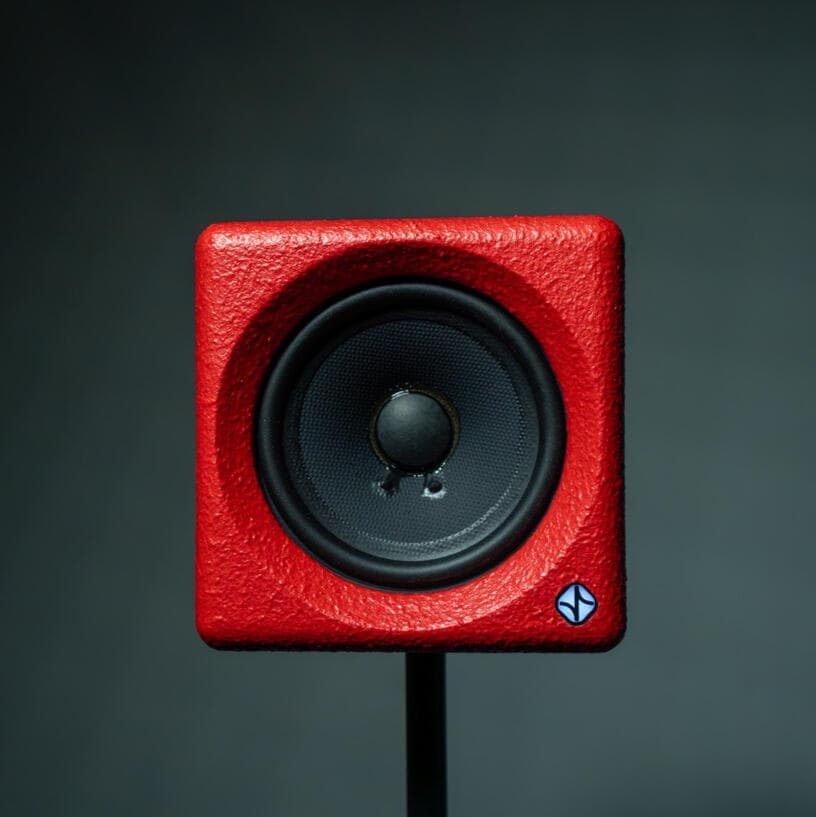
Shapes worth shortlisting are the compact end of the nearfield market: the IK Multimedia iLoud Micro Monitor for its size and onboard correction, the Genelec 8010 for its build, the single-driver cubes for their coherence and for having no port to damage, and our own Angry Box, which is a sealed 14 cm cube at 2.5 kg with a tailored bag for a pair. They are different trades on the same constraint.
Working in a Room You Did Not Choose
The monitor is half the problem. The other half is method, and it is the half you control.
- 1Set up away from the corners and away from the wall behind you if at all possible. A metre of clearance changes more than any setting.
- 2Get the tweeters to ear height and symmetrical. Books and hard cases work when stands did not come.
- 3Measure. Ten minutes with a measurement microphone and free software will show you what the room is doing before you make a decision based on it.
- 4Apply boundary compensation if the monitors have it and they are against a wall.
- 5Check against reference tracks you know intimately, at moderate level, before trusting anything.
- 6Do the decisions you can, and defer the low-end ones until you are home.
Rules of Thumb
Frequently Asked Questions
Can you mix on portable studio monitors?
Yes, with method. Compact monitors are honest through the midrange, which is where most mix decisions live. The low end in an unfamiliar untreated room is the part to be sceptical of, and the fix is measurement and reference tracks rather than a bigger speaker.
Are portable monitors better than headphones for travel?
They answer different questions. Headphones remove the room entirely, which is an advantage and also why they mislead about stereo width and low-end balance. A compact pair plus a familiar reference track gives you a room-based check that headphones cannot.
What should I look for in a monitor travel case?
Foam cut for the monitor rather than generic blocks, enough depth that the driver is never under pressure, and room for the cables. A tailored bag for the specific monitor is worth more than a bigger generic one.
Do I need stands when travelling?
You need ear height and symmetry, which is not the same as needing stands. Desktop stands pack small and are worth taking; failing that, hard cases and books get the tweeters up.
How do I deal with a bad hotel room acoustically?
Pull the monitors away from walls and corners, get them to ear height, put something soft on the first reflection points if you can, measure, and then limit yourself to decisions the room can support. Work the midrange and leave the bottom octave for home.
Conclusion
The portable monitor to buy is a sealed, compact one you already know, packed in a case cut for it, carried with a measurement microphone. Portability is a property of the system rather than the speaker, and the room at the far end will be the limiting factor whatever you bring. The honest limit: a good travel rig buys you reliable midrange decisions in an unfamiliar space, and the bottom octave stays a question you answer at home.
Sign up to hear more when we release something new


