



Room Correction,
Done In Hardware.
Every studio source in; corrected, time-aligned monitors out.
Skip The
Conversion.
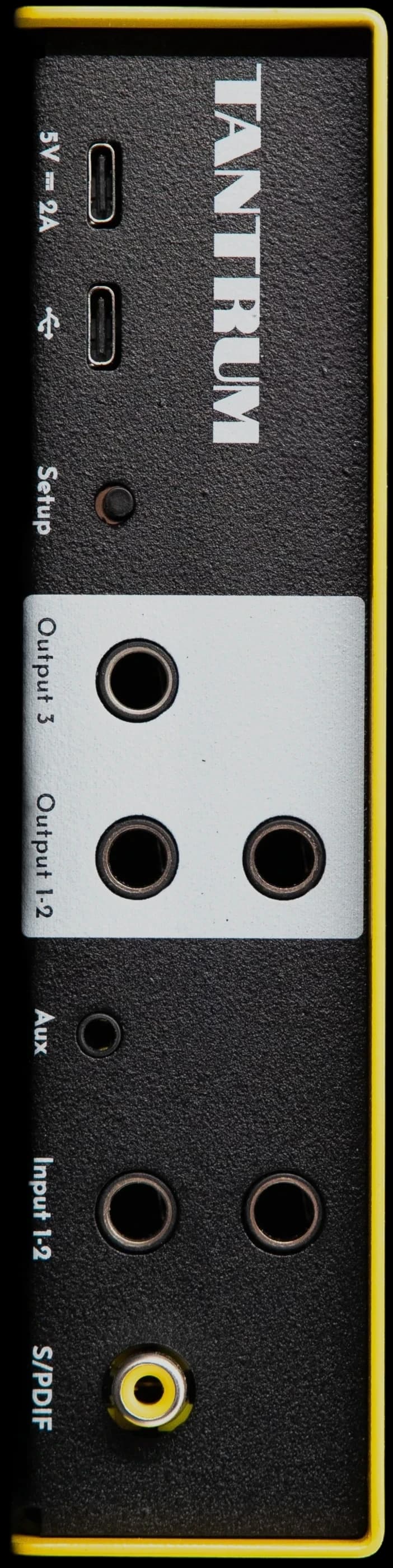
Most room correction boxes force an extra AD/DA step. NEXUS has USB audio and S/PDIF, so your chain stays digital. Plus the analog inputs take +20dBu before they flinch, and there's a stereo aux for whatever else turns up.
Any Speaker,
Any Room.
Mixes that translate, on speakers you already own. It measures your room, it corrects where it has confidence, doesn't waste headroom chasing nulls and, like a good partner, understands your speakers' physical boundaries. A minimum phase problem gets a minimum phase solution, which is why it doesn't sound like room correction, just good sound engineering.
Fix The
Time Domain.
You don't even know what's missing, but you hear what it costs: the low end you fight on every mix. A kick you keep pushing that never lands, and bass that sounds right in here and falls apart in the car. Once everything is in time, things start to make a lot more sense.
Everything
On A Button.
Switch between your mains and your reference speaker. Mute the sub. Control the volume. Recall a preset. Bypass the correction. Every one of those is a MIDI or OSC address via a fully customisable macro, so one button on a Stream Deck, or any other hardware controller, does it.
No Monitoring
Latency.
One millisecond from analog input to output. Track through it, monitor live, play in with the singer: one thousandth of a second leaves your drummer no excuse for being out of time.
Leaves No
Fingerprints.
0.0013% distortion: whatever the box adds sits about 98dB below the music. Noise floor 120dB down, sample rates up to 192kHz. Cleaner than a nun's Sunday confession.
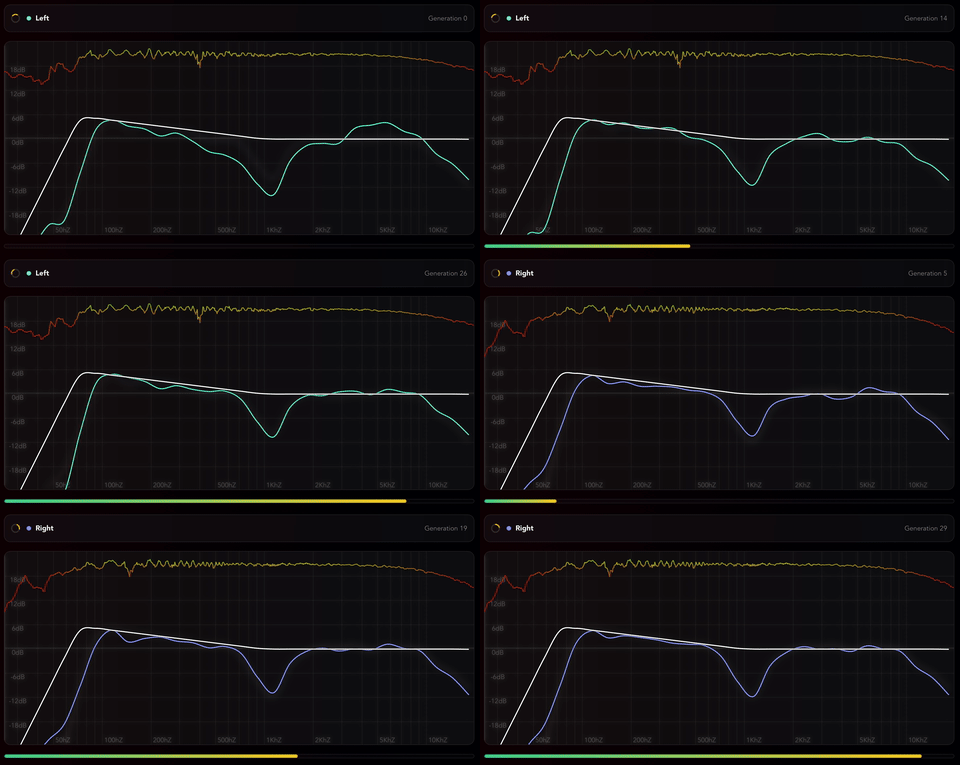
Room Correction Shouldn’t Require A PhD.
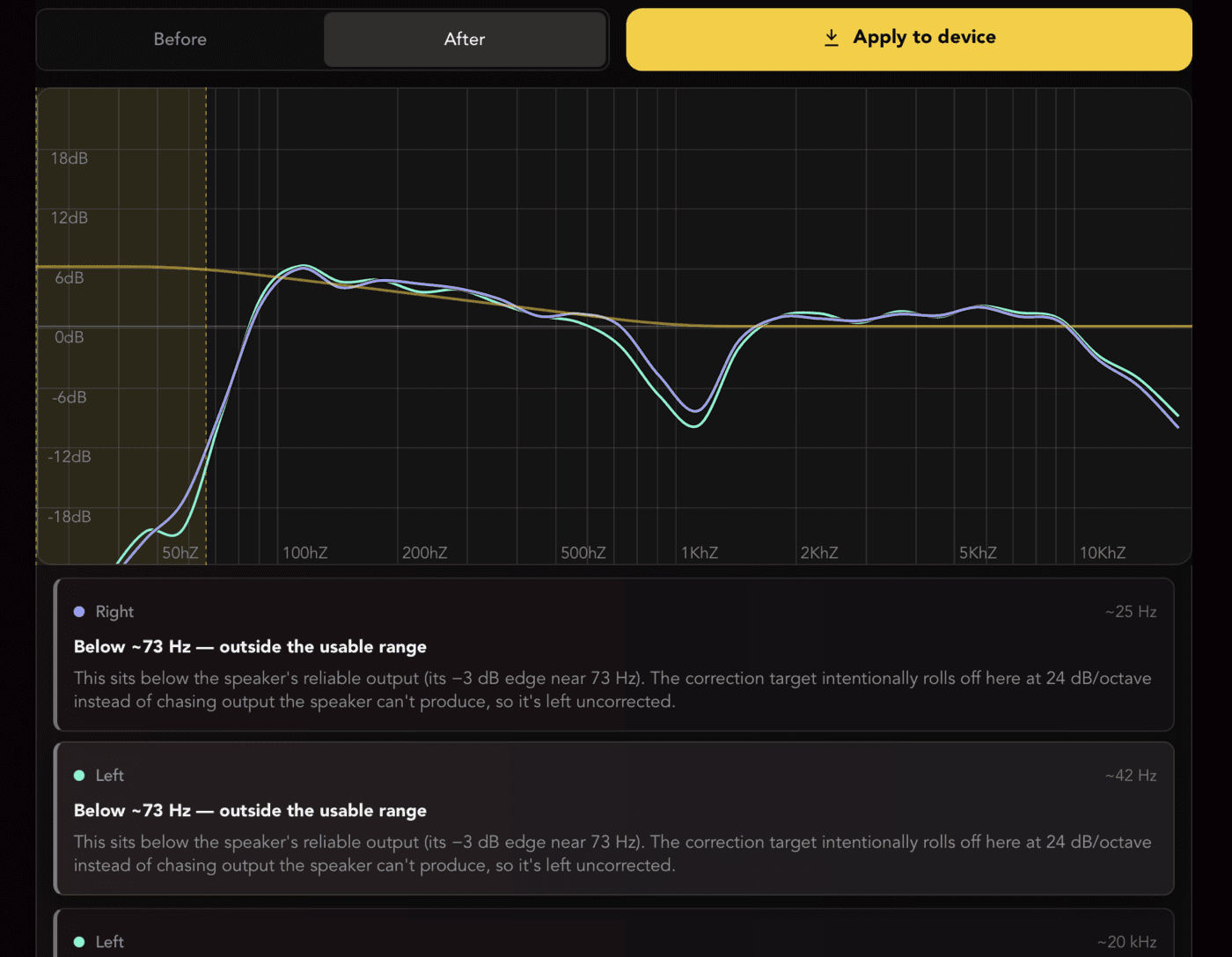
It Doesn’t Just Correct. It Tells You Why.
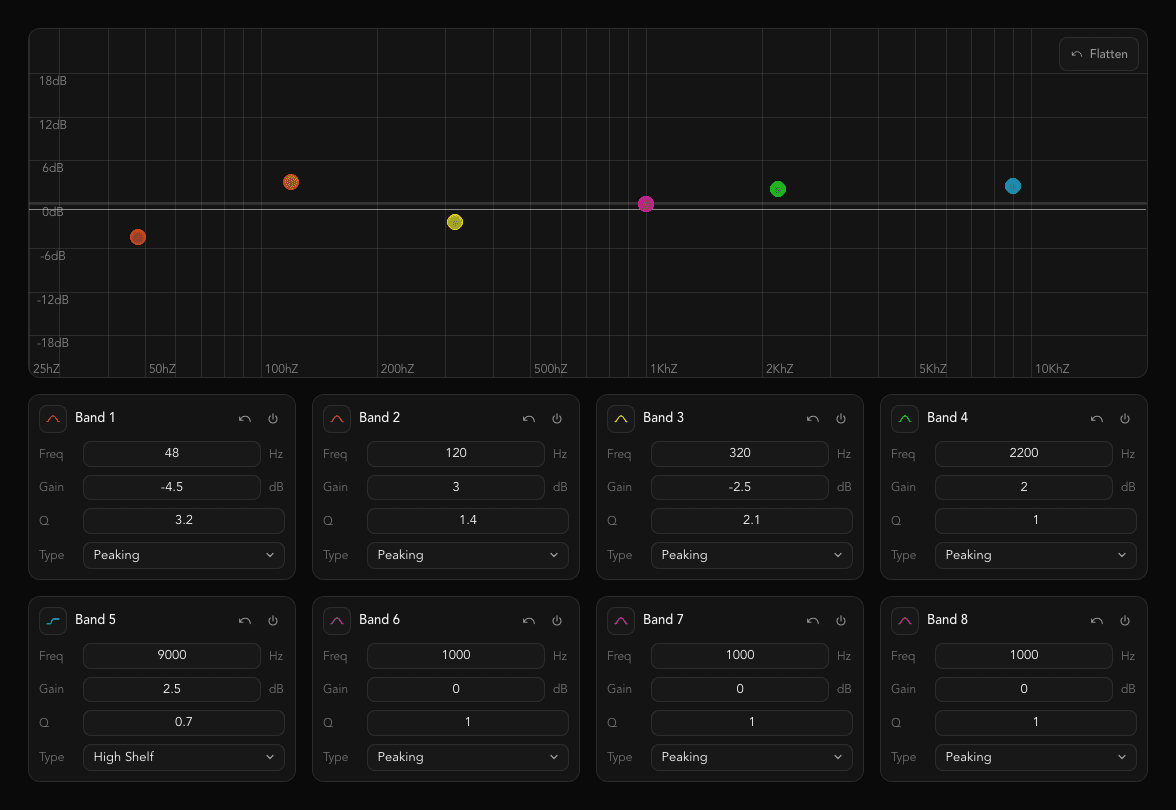
You Can Start Tonight.
Manual Tuning Toolkit For Experts
If you already tune rooms in Smaart or REW, you are not handing that over.
The Analyser
Dual-channel transfer function off pink noise: magnitude, phase and coherence, live. Averaging is exponential at 1.5 seconds, 500ms or 250ms, or a boxcar over the last 4, 8, 16 or 32 frames when you want the coherence figure to be honest. Smoothing runs from a raw trace through 1/48 octave up to a full octave, the coherence threshold is yours to set, multi-window analysis shortens the window as frequency climbs, and clock drift correction is there for when the mic and the outputs sit on different interfaces.
The Room Energy Plot
Under the response runs a room energy lane: direct to reverberant against frequency, as a trace and a heat strip. It answers what a magnitude plot cannot, which is whether that dip is the speaker or the room arriving late. Where the lane runs hot, you are looking at reflections, and no filter is going to fix those.
Phase, And The Tuner
Phase gets its own trace and its own tuner. Every visible snapshot becomes a needle on a dial, weighted 1/f so the bottom octaves are not outvoted by the top ones, and the verdict reads Locked, Close or Scattered. Dial delay into one trace and watch the needles converge: that is a sub lined up with the mains by hand, in the window that measured it.
Every filter is yours too: parametric bands on every output, delay, Butterworth or Linkwitz-Riley crossovers and all-pass rotators, with the output strip beside the charts so you move a control and watch the trace move. And when you do let it calculate, you still pick the estimator: minimum phase error or GCC-PHAT cross correlation.
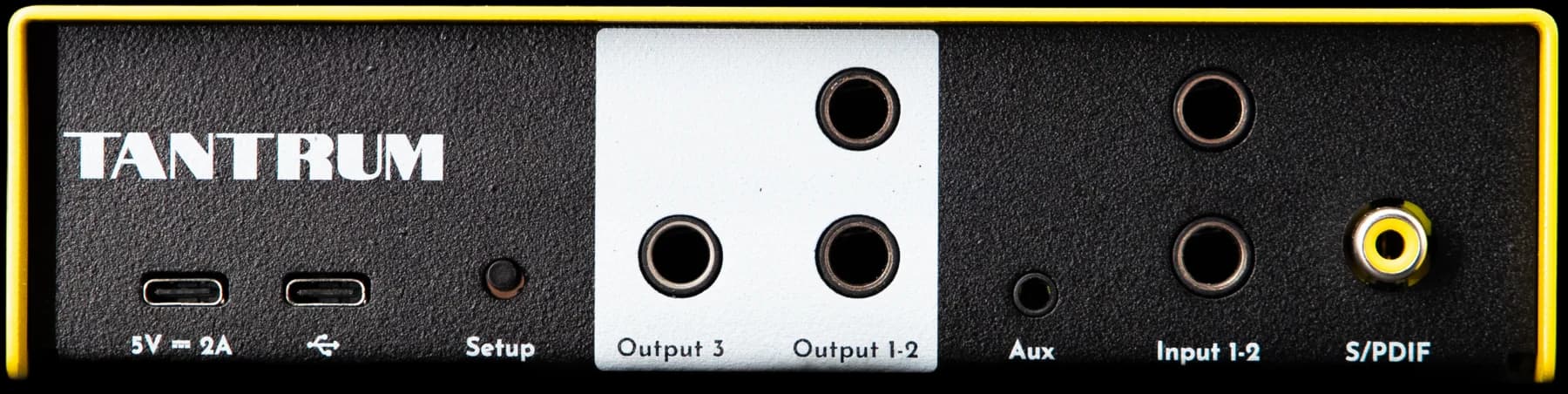
Specification
- 2 analog inputs, +20dBu
- Stereo aux input for phones & external players
- S/PDIF input (2 channels)
- USB audio: 2 channels playback, 2 channels record
- 2 analog outputs, +18dBu
- Subwoofer / mono / utility output, +18dBu
- USB-C control & audio · USB-C power
- 1U tall, 140mm x 100mm
- 15 filters per output
- Crossover, time alignment & all-pass filters
- Macros & remote control over MIDI + OSC
- Configured by Omnissiah, runs standalone
“Yes, but room correction sounds artificial.”
Fair Questions
“Room correction sounds artificial.”
Room correction earned its artificial-sounding reputation, and we agree: linear phase filters are the wrong answer to minimum phase room problems, and your transients pay for it. Our hot take is to approach it more like a human would: use a minimum phase solution, correct only what will actually respond, and walk away from the nulls instead of spending headroom on a problem that can't be fixed. Less time fighting the room, more mixes that translate.
“EQ can't fix a bad room.”
Correct, so we built the room diagnostics to show you which problems filters can solve and which ones need absorption, so you know when to buy traps instead of turning knobs. We take the first sort and leave the second alone. And there's one thing absorption can't touch at all: source timing. A sub that arrives late is still late in a perfect room.
“Shouldn't I treat the room first?”
Yes. Traps and placement first, every time. A null is two waves cancelling each other out, so no amount of boost fills it in and anything that claims otherwise is burning your headroom to prove a point. Treatment runs out of road in the low end unless you can give up serious floor space, which is what a small room, a rented flat or a hotel desk never has. If your room is already treated, this is the last 10%.
“I'd have to remember to bypass it.”
That's a plugin problem. This sits in the hardware under everything, so it's on for the mix, the bounce, the client's phone and the Zoom call, whether the computer is awake or not.
“I could build this with a miniDSP.”
You could. A Flex with Dirac and a measurement mic lands around £908, the licence is locked to that unit, and Dirac Bass Control can't be bought for a Flex at any price. Then you're running about 12ms, which is enough to have you bypassing it to track.
“How do I know it measured my room properly?”
It shows you. Every channel gets a card in plain language: what it corrected, what it deliberately left alone, and why it made that call.
Side By Side
Every one of these corrects a room. Here is what happens to your signal, your latency and your wallet on the way through.
| NEXUS | Audient ORIA Mini | IK ARC Studio | miniDSP Flex + Dirac | Trinnov Nova | Smaart + your own DSP | |
|---|---|---|---|---|---|---|
| Typical UK cost | Announced at launch | £379 | £268 | £908 | £3,995 | $1,299 plus a box |
| Measurements to calibrate | As low as 1 | 37, and 20 to 30 minutes | 7 quick, or 21 accurate | 9 to 17 | 1, with its own 3D mic | As many as you run |
| Sources in | 4 analog, S/PDIF, USB | 1 analog pair, optical | 1 analog pair | 1 analog pair, S/PDIF, optical, USB | 6 analog, S/PDIF, ADAT | Whatever your box has |
| USB audio, in and out | Yes | No | No | In only, no record | No, Dante or S/PDIF | No |
| Sub out and crossover | Yes | Yes | No | Yes | Yes | You build it |
| Corrects in the time domain | Yes, all-pass and per-speaker delay | No | Frequency and phase EQ only | Yes | Yes | You compute it |
| Latency, in to out | 1ms | 2.58ms | 1.4ms, or 42ms in linear phase | ~12ms | ~25ms optimised | Depends |
| Correction licence | None | Sonarworks, in the price | None | Dirac, locked to the unit | None | $399 a year, or $1,299 once |
| Stored presets | Unlimited macros | Four | App-switched | Several | Many | n/a |
One measurement. No licence. No extra conversion. The only other box here that manages all three costs four thousand pounds.
UK street prices including VAT, September 2026, from each manufacturer or a UK dealer. Competitor figures are their own published specifications; latency is quoted input to output throughout, including ours.
Asked Before You Did
What is it?
NEXUS is a line-level DSP speaker processor and monitor controller in one box. All your sources go in: two +20dBu analog inputs, a stereo aux for a phone or external player, S/PDIF, and USB playback from the computer. Corrected, time-aligned left, right and sub come out. The room correction, crossover, EQ and alignment all run on the device itself.
Does it need Omnissiah?
You set it up with Omnissiah over USB-C: measurement, correction, crossover, alignment, all of it. Once the settings are written to the box it runs standalone; the computer can be off, asleep or in another building and nothing changes.
What systems does it suit?
It sits between your sources and your powered monitors or amplifiers. Stereo pairs and 2.1 systems with a sub are the home ground: the third output is a dedicated subwoofer, mono or utility feed, and the crossover and time alignment exist exactly for making a sub and a pair of mains behave as one system.
When does it ship?
When it is ready, and we are not going to pretend to know the date yet. The form on this page is the honest answer: leave your email and you hear the day it ships, before anyone else.


