


Linear-Phase Room Correction: The Trade-Offs
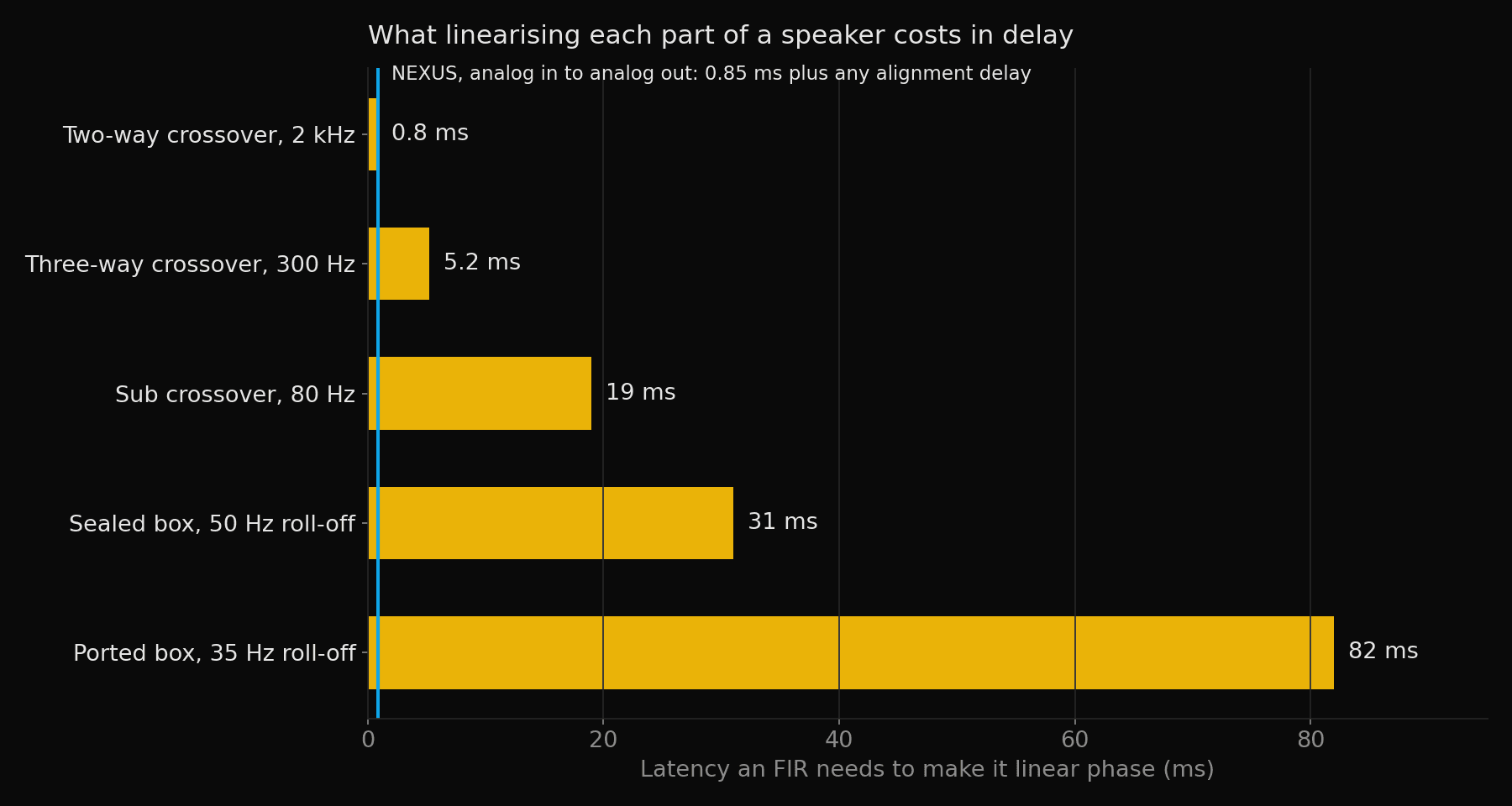
A linear-phase FIR filter can delay the early frequencies of a speaker until they line up with the late ones, so every frequency arrives together. The filter delays every frequency to match the one with the most group delay, which in the bass means tens of milliseconds of latency (see Where the Latency in Linear-Phase Room Correction Comes From). Linearising a 2 kHz crossover costs under a millisecond. An 80 Hz sub crossover costs about 19 ms, a sealed box rolling off at 50 Hz about 31 ms, and a ported box at 35 Hz about 82 ms. Linear-phase filters also ring before transients, and a correction aimed at the room's phase above 1 to 2 kHz holds at the microphone and not a few centimetres away, where a 5 cm move changes a path by 105 degrees at 2 kHz.
What Linearising a Speaker Does
Every speaker delays its bass relative to its treble. The box rolls off below its tuning and the crossover splits the band, and both are filters that shift the phase of the frequencies around them. The result is excess group delay: about 5 ms for a sealed box rolling off at 50 Hz, 15 to 20 ms for a ported box at 35 Hz, and about 0.2 ms at a 2 kHz crossover.
A phase-inverse FIR filter applies the mirror image of that delay. It cannot make the bass arrive sooner, because no real-time filter can output a sound before it receives it. It holds back the treble and midrange instead, until they arrive as late as the bass. The filter's latency is therefore set by the frequency with the most group delay.
- Linear phase
- A response whose group delay is the same at every frequency. It is a pure delay plus whatever magnitude shaping the filter applies.
How Much Latency Linearising Costs
Linearising a speaker costs latency that grows as the corner falls. A phase-inverse FIR needs 0.8 ms for a 2 kHz crossover, 19 ms for an 80 Hz sub crossover, 31 ms for a sealed box rolling off at 50 Hz and 82 ms for a ported box at 35 Hz, measured as pre-response to -60 dB. Latency does not matter for playback, but it does when you hear yourself through the system, as in tracking.
Pre-Ringing
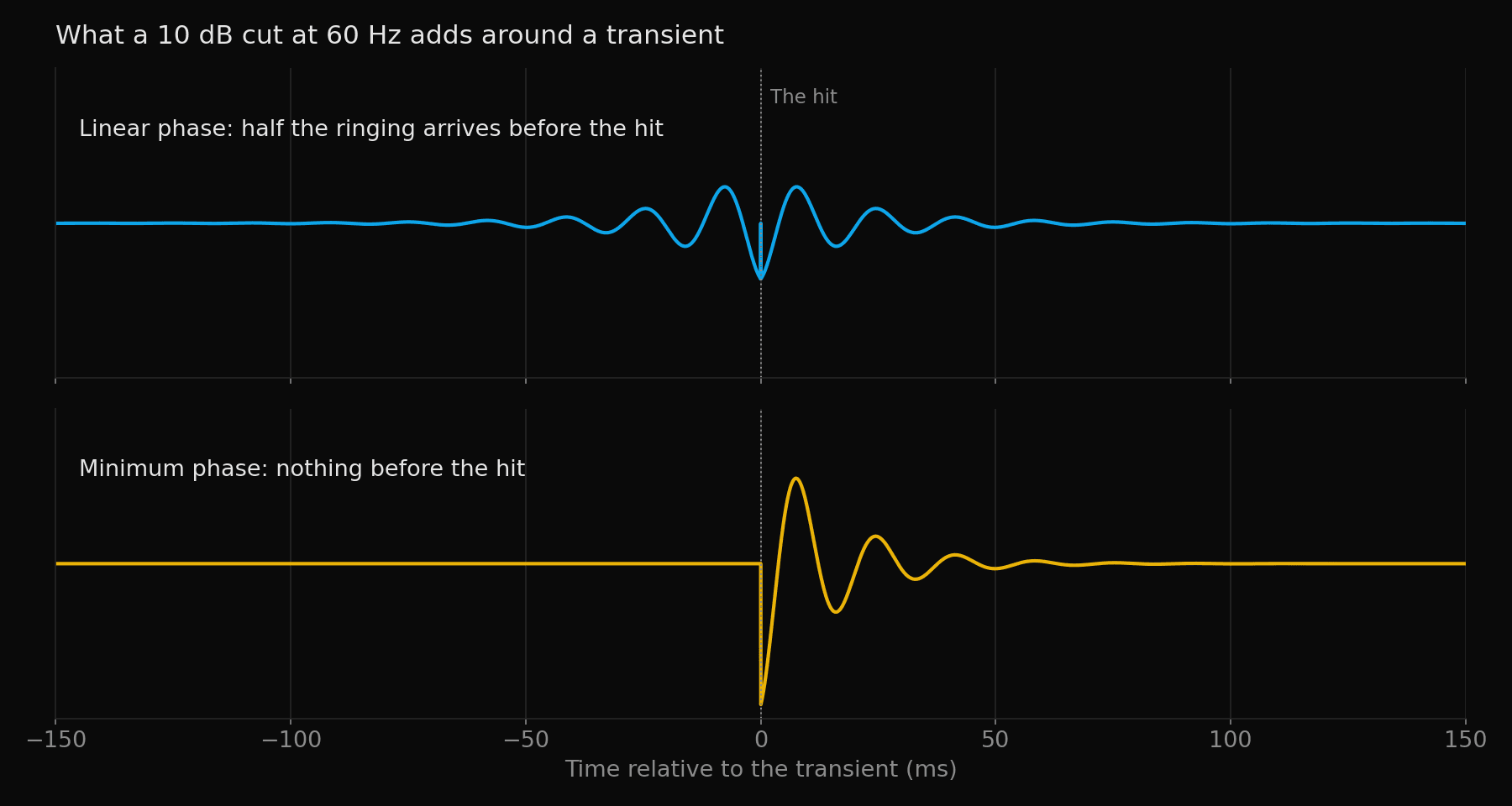
A linear-phase filter's impulse response is symmetric in time, so any ringing it adds appears before the transient as well as after it. The plot at the top of this page shows it for a single 10 dB cut at 60 Hz: the linear-phase version starts moving about 50 ms before the hit. A minimum-phase filter with the same magnitude response rings only after the hit, where the room's own decay already sits.
Pre-ringing arrives before the transient that would otherwise mask it. None of the sources behind this series measures when it becomes audible, so judge a linear-phase correction on kicks and plucks at matched level.
Where pre-ringing comes from in practice
A phase inverse that exactly matches the speaker leaves a clean impulse at the seat where it was measured. Pre-ringing appears wherever the correction and the acoustics disagree: magnitude cuts built as linear-phase filters, a seat other than the measured one, and any room reflection included in the inverse.
Room Phase Correction Holds at One Seat
A speaker's own excess phase, from its box and crossover, is much the same anywhere in front of it. A measurement at the listening position also captures the room, and above 1 to 2 kHz the measured phase includes the room's reflections, and a 5 cm head movement changes a path's phase by 105 degrees at 2 kHz. A correction that inverts the phase at the microphone leaves a phase error at every head position other than the microphone's.
The target that holds across the listening area is therefore the speaker's own excess phase, not the room's. A correction aimed at the speaker therefore covers the box roll-off and the crossovers.
What Linear Phase Removes, Feature by Feature
Weigh each feature against what it buys. A 2 kHz crossover adds about 0.2 ms of group delay. Blauert and Laws (1978) found listeners needed about 1 ms of variation near 2 kHz before they could detect it, and the group delay study puts a modelled two-way, from 200 Hz up, at 0.10 times the threshold at its worst frequency, before any correction. Linearising it still costs 0.8 ms of latency, so the filter adds delay to remove a difference below what listeners detected. The bass cases are where the excess group delay is large, and they are also where the filter is longest, the pre-ringing reaches furthest and the audibility of the original problem is least certain.
Our recommendation: if your monitors are sealed, skip linear-phase correction. The study puts a modelled sealed two-way at 0.14 times the threshold if it scales with the period below 500 Hz and 1.29 times if it is held at 3.2 ms, and removing it costs 31 ms. If you mix on ported speakers, only play back through the system, and never track through it, a bass-only linear-phase correction is a reasonable experiment. Judge it on transients at matched level.
An IIR all-pass filter cannot flatten the bass group delay at low latency either. The reason is in Where the Latency in Linear-Phase Room Correction Comes From, and what NEXUS and Omnissiah do instead is in Phase in NEXUS and Omnissiah.
Do's and Don'ts
- ✓Ask for the latency with correction active, from input to output.
- ✓Compare linear-phase and minimum-phase corrections on kicks and plucks at matched level.
- ✓Aim linear-phase correction at the speaker's crossover and box, measured close and on axis.
- ✓Align speakers that share a band first. Alignment costs a few milliseconds of delay and removes a 3.2 dB dip for a sub 2.9 ms late at 80 Hz.
- ✕Track or perform through a correction with tens of milliseconds of latency.
- ✕Invert room phase above 1 to 2 kHz from a single microphone position.
- ✕Linearise a midrange crossover expecting to hear it. Its delay is about 0.2 ms against a threshold of about 1 ms.
- ✕Assume a flat phase trace at one seat means a coherent system everywhere.
Frequently Asked Questions
Is linear-phase room correction better?
Not as a rule. It can remove a speaker's excess group delay, but the useful targets are in the bass, where the filter adds 19 to 82 ms of latency and rings before transients. For a modelled sealed two-way the bass group delay is 0.14 to 1.29 times the threshold, depending on which reading of the bass threshold you take, and removing it costs 31 ms.
Why does linear-phase correction add latency?
It cannot make late bass arrive early, so it delays everything else to match, and the bass delay is tens of milliseconds. The mechanism and the filter lengths are in Where the Latency in Linear-Phase Room Correction Comes From.
What is pre-ringing?
Ringing that starts before a transient, because a linear-phase filter's response is symmetric in time. Pre-ringing arrives before the transient that would otherwise mask it, so compare it with a minimum-phase correction on sharp attacks at matched level.
Can minimum-phase filters fix group delay?
They fix the timing of minimum-phase problems such as a resonant peak, along with its level. Flattening a sealed box's bass group delay with all-pass sections takes about 79 of them, against 15 filters per output on NEXUS. An all-pass filter can only add delay, and each section carries a fixed amount of it.
Does linear-phase correction work for the whole room?
Only the part of the phase that belongs to the speaker holds across the listening area. Above 1 to 2 kHz a 5 cm head movement changes a path's phase by 105 degrees at 2 kHz, so inverting the room's phase fixes the microphone position only.
Conclusion
Linear-phase correction can flatten a speaker's group delay, at a latency that rises as frequency falls, from 0.8 ms at a 2 kHz crossover to 19 ms at 80 Hz. The midrange crossover adds about 0.2 ms against a threshold of about 1 ms. The expensive part, the bass, costs 19 to 82 ms, rings before transients and removes a group delay whose audibility the research has not settled. Choose it for playback-only work on ported speakers, where the modelled bass group delay is 15 to 20 ms, and decide by listening to transients at matched level.
Glossary
- FIR filter
- A filter built from a finite list of coefficients, which can be designed for exactly linear phase.
- Phase-inverse filter
- A filter that applies the opposite of a system's excess phase so the combination is a pure delay.
- Pre-ringing
- Ringing that starts before a transient, from the time-symmetric response of a linear-phase filter.
- Excess group delay
- Group delay left once the arrival time is removed, mostly from box roll-off and crossovers.
Sign up to hear more when we release something new


