



Phase in NEXUS and Omnissiah: What We Correct and Why
A single speaker's phase at your seat is mostly the time its sound takes to reach you, and a change in that time alone is inaudible. The phase difference between two speakers that share a band determines whether they add or cancel. NEXUS and Omnissiah measure each speaker against the other at your seat and match their phase responses with delay, polarity and optional all-pass filters: a sub 2.9 ms late through an 80 Hz crossover leaves a 3.2 dB dip, and 2.9 ms of delay on the mains removes the cancellation. Flattening a single speaker's phase is left out by design. A sealed speaker's bass group delay sits between 0.14 and 1.29 times the Blauert and Laws threshold, depending on how that threshold is extended below 500 Hz. The cost is an FIR filter adding about 31 ms to NEXUS's 0.85 ms analog in to analog out, with pre-ringing wherever the correction and the room disagree, and an all-pass version would need about 79 sections.
LearnWhy You Can't Hear Absolute PhaseWhat Gets Corrected
- 1Level. Peaks and broad imbalances are corrected with minimum-phase IIR filters. For a minimum-phase problem, such as a room mode's peak at the seat, fixing the level fixes its timing too. Deep nulls are left alone. A null is a reflection cancelling the direct sound, and a boost raises both by the same amount.
- 2Alignment. Every output gets a delay and a polarity, measured at the listening position. By default the sub is aligned to the mains. Set Time-Align Tops to All speakers and left and right are aligned to each other as well, for rooms where they sit at different distances.
- 3Phase through the crossover, optionally. With Phase Correction on, Omnissiah fits all-pass filters so each speaker's phase follows the reference through the band they share. Their corners are at or below 1.5 kHz. It is off by default.
The delay is found by matching phase across the overlap rather than by lining up impulse peaks. Through a narrow crossover there is a ladder of other delays that also add, alternating in polarity, each rung costing a little more summed level (about 1 dB, then about 3 dB, at 80 Hz). Omnissiah takes the shortest delay that brings the phases within 10 degrees, which keeps the added latency lowest, at the summation cost of that rung.
Why Alignment Gets the Filters
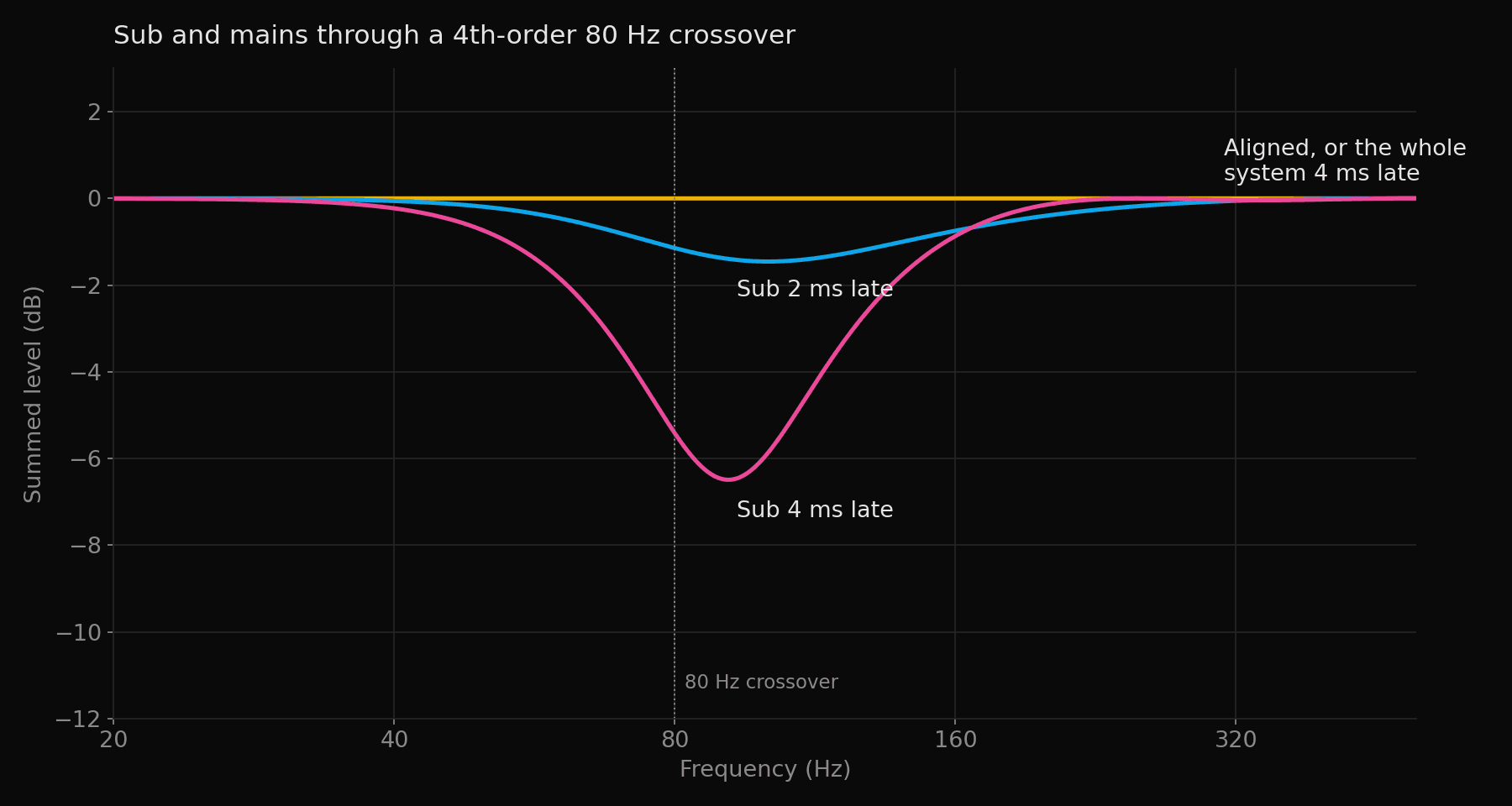
Two speakers playing the same octave sum at your seat, and if one arrives late they partly cancel. Through a 4th-order crossover at 80 Hz, a sub 2 ms late costs 1.5 dB, 4 ms costs 6.5 dB and 5 ms costs 11.7 dB. A sub one metre further back than the mains is about 2.9 ms late before its own filters are counted. Acoustic treatment changes reflections, not the arrival time of each speaker's direct sound, so it leaves this dip in place.
A crossover cancellation is a broad dip, about an octave wide. Bücklein (1981) found broad response deviations audible at about 1 to 2 dB and narrow ones from about 3 to 5 dB, with dips harder to hear than peaks of the same size. A 3.2 dB dip an octave wide sits above that broad figure, though 80 Hz lies below the bands Bücklein found most sensitive, 200 to 600 Hz and 2 to 6 kHz.
Fixing the dip costs only delay. The speaker that arrives first is held back until the late one catches up, so a sub 3 ms late adds 3 ms to the mains and nothing else changes. NEXUS holds up to 8.5 ms per output. If a room needs more, alignment is skipped with a warning rather than applied wrongly.
Left and right are polarity-checked as standard and time-aligned only when you ask. Two identical speakers at equal distances already match, and above 1 to 2 kHz the remaining difference between them comes from reflections that move with your head, which is why the all-pass pass keeps its filter corners at or below 1.5 kHz.
Why an All-Pass Cannot Flatten a Speaker
All-pass filters change phase without changing level, so they look like the natural tool for flattening a speaker's group delay at low latency. Two exact results show that they cannot.
- 1A stable all-pass filter only ever adds delay. Its group delay is zero or positive at every frequency. So it cannot pull late bass forward. It can only hold back everything above the bass until the bass catches up.
- 2Each second-order all-pass section adds the same total amount of delay, wherever it is tuned and however sharp it is. Add up the delay it gives each frequency across the whole audio band and the total is always one second-hertz. Lifting a band of B hertz by D seconds needs at least D times B sections.
| Feature | Delay to add (D) | Band to lift (B) | Sections needed |
|---|---|---|---|
| Two-way crossover, 2 kHz | 0.2 ms | About 2 kHz | 0.4 |
| Sealed box, 50 Hz roll-off | 5 ms | Up to 16 kHz | 79 |
| Ported sub plus 80 Hz crossover | 25 ms | Up to 16 kHz | 400 |
The crossover row is feasible and already about 0.2 ms against a threshold of about 1 ms. The bass rows need 79 and 400 sections, and NEXUS has 15 filters per output. Optimised cascades of four sections confirm the count. A two-way from 200 Hz up goes from 0.10 to 0.07 times the threshold, and a ported two-way from 4.23 to 3.76 with the threshold held at 3.2 ms below 500 Hz.
An FIR filter could flatten the bass group delay, at 19 ms for an 80 Hz crossover and up to 82 ms for a ported box, with pre-ringing wherever the correction and the acoustics disagree. Linear-Phase Room Correction: The Trade-Offs covers that trade, and the mechanism is in Where the Latency in Linear-Phase Room Correction Comes From.
What Is Left Alone, on Purpose
- Single-speaker group delay. A modelled sealed two-way is 0.14 to 1.29 times the threshold depending on the bass reading, and a ported two-way 0.36 to 4.23 times. Removing either takes 31 or 82 ms of FIR latency or 79 to 400 all-pass sections.
- Room phase above 1.5 kHz. A 5 cm head movement changes a path's phase by 105 degrees at 2 kHz, so a correction fitted at the microphone does not hold at your ears.
- Modal ringing as a target. A minimum-phase cut matched to a room mode shortens its decay as a side effect, but nothing in the optimiser aims for decay, and the app does not yet show a decay view to prove it.
- Every seat but one. Calibration is measured at one microphone position by default.
Phase Correction is off by default. Turn Phase Correction on when the tuner still shows the needles apart after alignment. The extra pass makes calibration take longer.
How to Check the Alignment in Your Room
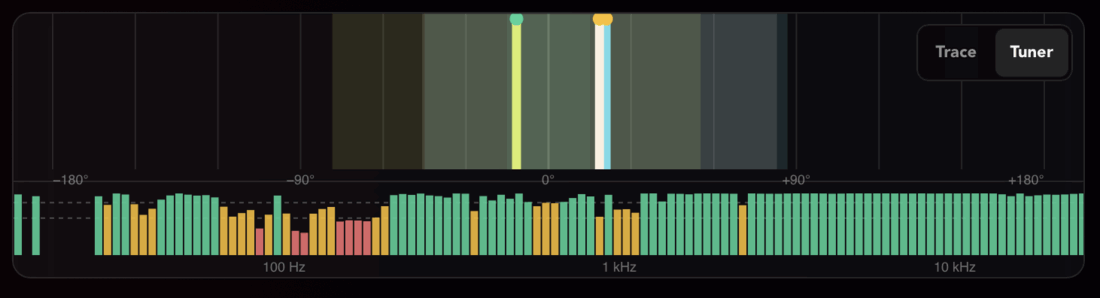
Re-measure after applying. In the tuner, show the sub and mains snapshots together. Their needles should sit side by side and the verdict should read Locked. The summed response should no longer show a dip around the crossover. If the needles move apart after applying, something in the signal chain differs from what was measured.
Rules of Thumb
Frequently Asked Questions
Does NEXUS do phase correction?
It aligns speakers to each other with per-output delay, polarity and all-pass filters through the crossover. It does not linearise single speakers, because flattening a sealed box's bass delay takes about 79 all-pass sections against 15 filters per output and an FIR filter would add 19 ms or more of latency.
Why doesn't Omnissiah use FIR filters?
The phase errors FIR could remove are either already below the audible threshold, as at a midrange crossover, or in the bass, where removing them costs 19 to 82 ms of latency and pre-ringing on transients. Alignment between speakers is the larger audible error and costs only a few milliseconds of delay.
Which speaker gets the delay?
The one that arrives first. A sub is usually late at the seat, so the mains are held back to meet it. The added latency equals the sub's lateness and applies to the delayed outputs only.
What does Time-Align Tops do?
With the default, Subwoofer only, the sub is aligned to the mains and left and right are polarity-checked. With All speakers, left and right are time-aligned to each other too. Use that when the two sit at noticeably different distances from you.
Should I turn on Phase Correction?
Try Phase Correction when the tuner's needles still sit apart after alignment. Phase Correction fits all-pass filters with corners at or below 1.5 kHz and makes calibration take longer.
Does alignment add latency?
Only the alignment delay, on the outputs that receive it. NEXUS runs at 0.85 ms analog in to analog out, plus any alignment delay on the outputs that receive it. Aligning a sub that is 3 ms late adds 3 ms to the mains.
What if my sub is more than 8.5 ms late?
NEXUS holds up to 8.5 ms of delay per output. Beyond that, alignment is skipped with a warning. Moving the sub closer brings it into range at 2.9 ms per metre. Through an 80 Hz crossover, flipping its polarity reaches an equivalent setting about 5.5 ms shorter, at about 1 dB.
Conclusion
Speakers that share a band are aligned with delay and polarity, measured at your seat, with an optional all-pass pass through the crossover. Level problems get minimum-phase correction. Single-speaker group delay is left alone, because an all-pass cannot flatten it and an FIR would cost 19 to 82 ms and ring before a transient wherever the correction and the acoustics disagree. The processing stays at 0.85 ms analog in to analog out, plus any alignment delay on the outputs that receive it, and the tuner shows whether the needles came together after alignment.
Sign up to hear more when we release something new


