



Time-Aligning Left and Right: When It Helps
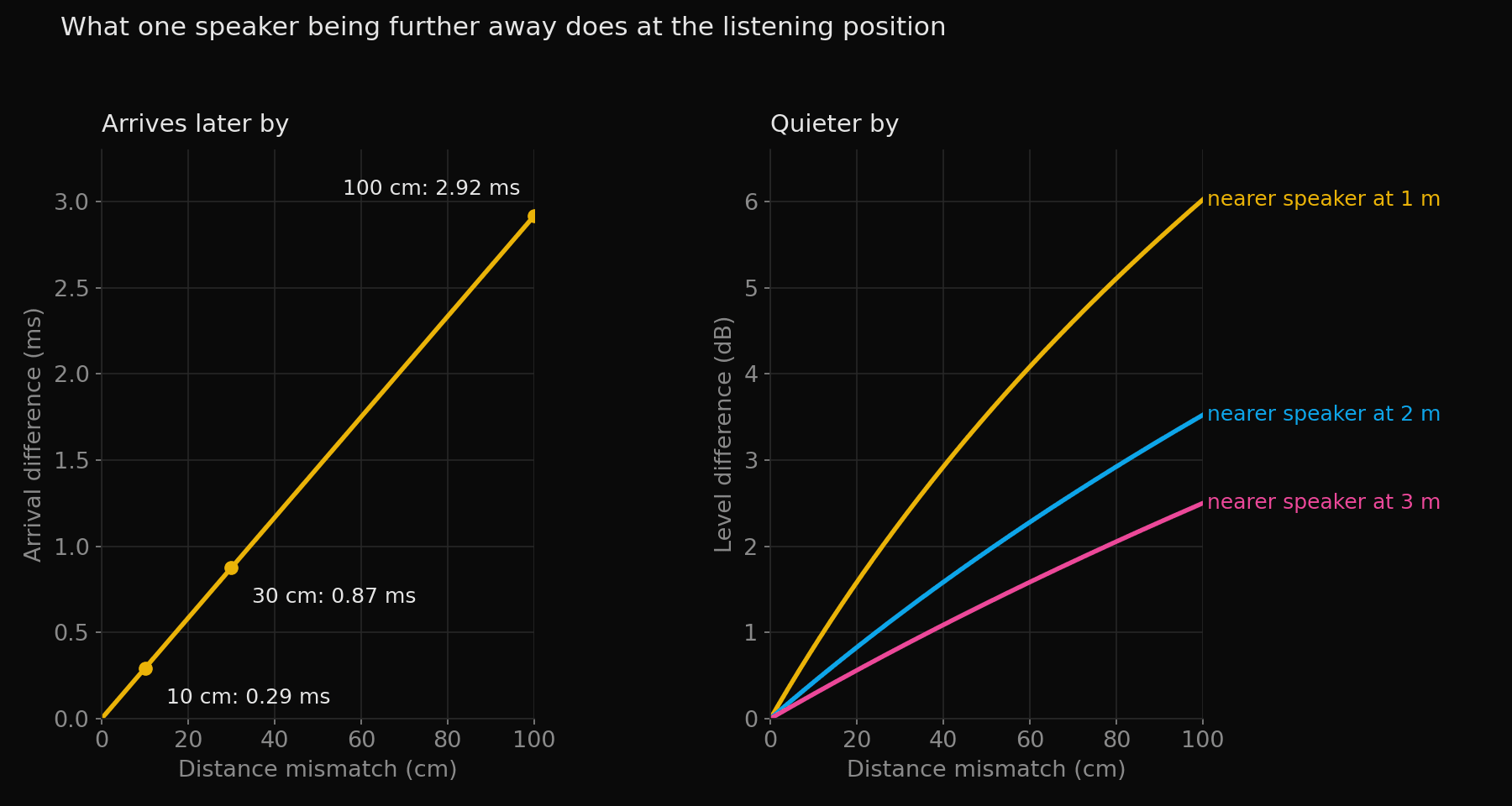
Two speakers of the same model carry the same phase of their own. What differs at the seat is what the room and the distances add. Every 10 cm of extra distance makes a speaker arrive 0.29 ms later and, at a 2 m listening distance, 0.4 dB quieter, and a 30 cm mismatch puts the first dip in a centre-panned signal at about 570 Hz. Below about 500 Hz that difference survives head movements of a few centimetres, so a delay on the nearer speaker holds. Above 1 to 2 kHz the phase moves with the head, so correcting it at one microphone position does not hold.
A Matched Pair Has Identical Excess Phase
Two speakers of the same model have the same excess phase, within manufacturing tolerance. The box roll-off and the crossover add the same delay to the same frequencies on both sides.
The difference at the seat therefore comes from outside the speakers. Distance is one part, and the table below gives its size. The room is the rest: a wall nearer one speaker, a window on one side, a desk edge or a rack beside one of them. Each gives one channel reflections that the other does not get.
Imaging is the sense that a sound sits at a place between the speakers, and it depends on how the two channels arrive at your ears. When the two arrive with different timing or level, the image moves. Left and right alignment therefore corrects the difference in timing and level between the two paths.
What a Distance Difference Does
Sound travels about 343 m/s, so each extra metre of path is 2.9 ms and each 10 cm is 0.29 ms. Level falls with distance as well. In free field it drops 6 dB per doubling, so with the nearer speaker 2 m away, a speaker 30 cm further back is 1.2 dB quieter. A small room follows this law less cleanly, especially in the bass.
The image moves towards the nearer speaker. A centre image starts to move once the arrival difference reaches a few tenths of a millisecond, and sits fully on the earlier speaker near 1 ms. A level difference of a few dB moves the image too.
| Mismatch | Arrives later by | Direct sound quieter by | First dip, same signal from both |
|---|---|---|---|
| 10 cm | 0.29 ms | 0.4 dB | 1.7 kHz |
| 30 cm | 0.87 ms | 1.2 dB | 570 Hz |
| 50 cm | 1.46 ms | 1.9 dB | 340 Hz |
| 100 cm | 2.92 ms | 3.5 dB | 170 Hz |
The last column is a centre-panned signal, which plays from both speakers at once. The two copies add at the seat, and a delay of Δt between them first cancels at 1 / (2 × Δt). The 30 cm row lands at 570 Hz, in the range where both speakers carry vocals, snare and the body of most instruments. The dip is partial, because the level difference stops the cancellation being complete.
Where the Difference Holds Up
A measurement taken at one microphone position gives the difference at that point. Whether it still applies when you lean to one side depends on frequency. Below about 500 Hz the wavelength is 69 cm or more, so the difference between two speakers at the seat survives head movements of a few centimetres.
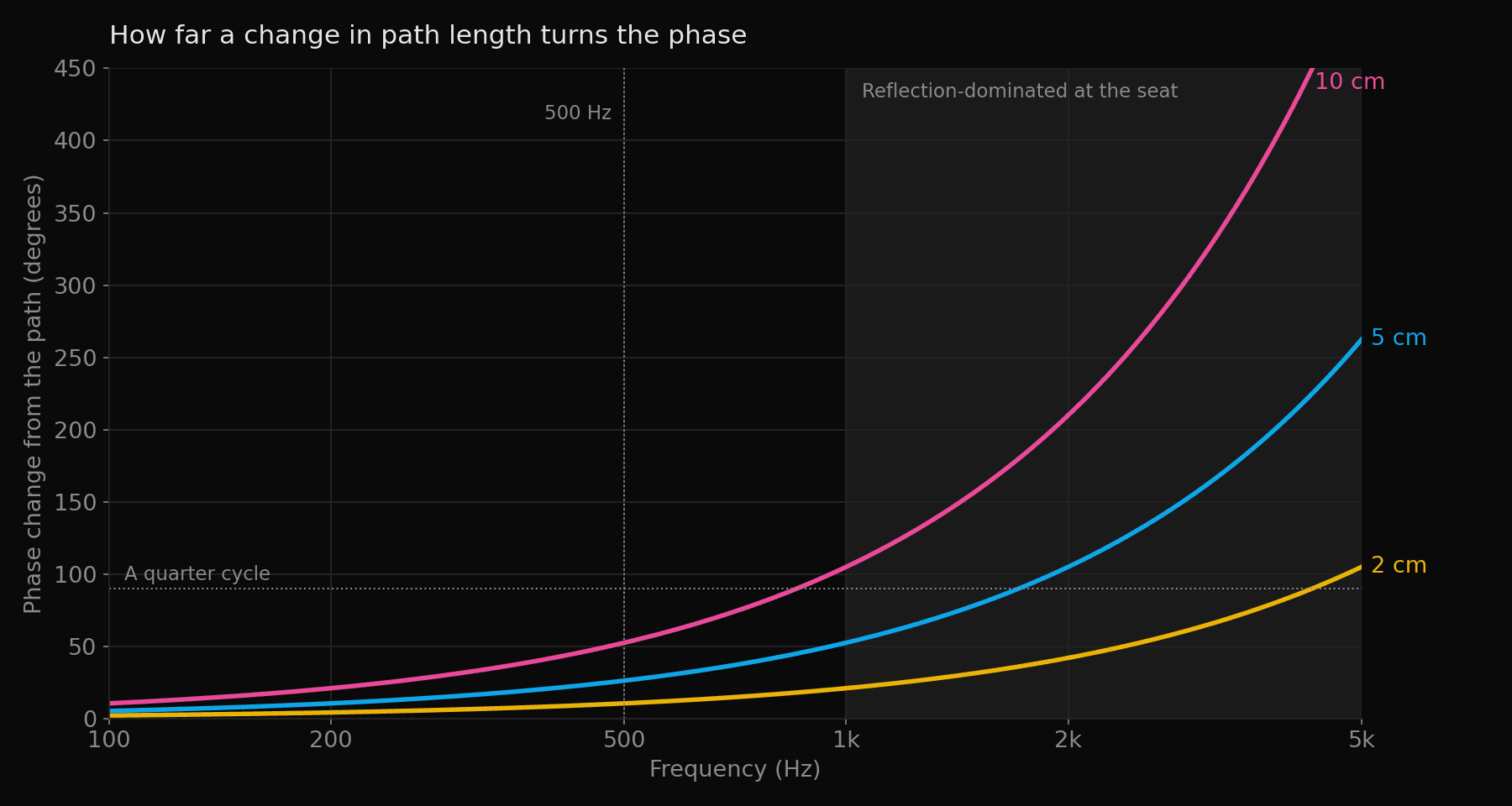
Above 1 to 2 kHz the wavelength is 17 to 34 cm and the same movement turns the phase by a large fraction of a cycle. What remains once the delay is removed is mostly reflections from the desk, walls and ceiling, and it changes with every centimetre of head position. A filter fitted to those reflections is right at the microphone and wrong close by.
A delay on the nearer speaker helps when the distances differ, and the amount does not depend on where your head is within a few centimetres, since a 5 cm sideways move changes the arrival difference by only 0.15 ms. Phase work at high frequency does not hold across a head's movement. The fuller argument for why is in the article on absolute phase.
Check Polarity First
A speaker wired or filtered with reversed polarity turns every frequency by 180 degrees on its side. In the bass, where both speakers play the same signal, the two cancel at the centre. With 10 cm of mismatch at 2 m, the reversed pair sums 26 dB below the in-phase pair at 50 Hz and about 20 dB below at 100 Hz. A polarity switch fixes the cancellation.
Check polarity before touching delay, because a delay chosen on a polarity-reversed pair compensates for a polarity error instead of a distance. On an impulse response measured from each speaker, the first large peak should point the same way on both. Polarity, Phase and Delay Are Not the Same Knob covers what each control changes.
Doing It in Practice
- 1Check polarity on each speaker with the same signal.
- 2Measure the arrival time from each speaker at the listening position. Use the impulse peak rather than a tape measure, because a speaker's acoustic centre is inside the box.
- 3Delay the earlier speaker by the difference. 0.87 ms is 30 cm of path.
- 4Match the level separately. A delay does nothing for a level difference.
- 5Measure again, then repeat with your head moved a few centimetres each way. The measurements below 500 Hz should agree.
The delay goes to the nearer speaker, because a speaker cannot be made to arrive sooner. Delaying both by the same amount is only latency. If the two are within a few centimetres of equal distance, the table says the gain is small: 10 cm is 0.29 ms and 0.4 dB at a listening distance of 2 m.
In Omnissiah
In Omnissiah, the NEXUS calibration app, the setting is Time-Align Tops. The default is Subwoofer only, which aligns the subwoofer to the tops and leaves left and right polarity-checked but at 0 ms. Switch it to All speakers when left and right sit at noticeably different distances, and the earlier speaker receives the delay. Phase Correction is a separate pass, off by default, that fits all-pass filters with corners at or below 1.5 kHz. It makes calibration longer and helps only where the remaining phase error is large enough to hear.
Do's and Don'ts
- ✓Check polarity on both speakers before choosing a delay.
- ✓Measure arrival time at the listening position and delay the earlier speaker by the difference.
- ✓Match level separately from delay.
- ✓Judge the result below 500 Hz, where it holds across a few centimetres of head movement.
- ✓Measure again after any speaker, desk or seat has moved.
- ✕Delay both speakers by the same amount and expect the image to change.
- ✕Use a delay to compensate for a level difference. The two are separate errors.
- ✕Treat a phase difference above 1 to 2 kHz at one microphone position as a fault to correct.
- ✕Assume a matched pair in an asymmetric room reaches the seat identically.
- ✕Skip the polarity check because both speakers are the same model.
Frequently Asked Questions
Do I need to time-align left and right?
Only if the two speakers are at different distances from your seat. A 10 cm difference is 0.29 ms and about 0.4 dB at 2 m, which changes little. A 30 cm difference is 0.87 ms and puts a partial dip near 570 Hz in anything panned to the centre, and a delay fixes that.
Which speaker gets the delay?
The nearer one, because the arrival of the further one cannot be brought forward. Delay the nearer speaker by the difference in arrival time, which is the extra distance divided by 343 m/s.
How much does a distance difference move the stereo image?
The image drifts towards the nearer speaker. The arrival and level differences are exact, at 0.29 ms and about 0.4 dB per 10 cm at 2 m. The image starts to move at an arrival difference of a few tenths of a millisecond and sits on the nearer speaker at about 1 ms.
Does the same model of speaker guarantee a matched pair?
It guarantees matched excess phase within manufacturing tolerance. The room is a separate factor. A wall closer to one speaker or a rack beside it changes what reaches the seat from that channel, and no setting inside the speaker corrects that.
Why does phase correction not hold above 1 or 2 kHz?
The phase there includes reflections, and the reflection paths change with head position. A 5 cm move turns a path by 105 degrees at 2 kHz and 26 degrees at 500 Hz. A correction fitted at one microphone position is right there and wrong a few centimetres away.
How do I check polarity?
Measure the impulse response of each speaker and compare the first large peak. If one points up and the other down, one speaker is reversed. A test signal and a polarity checker give the same answer. Fix it before choosing a delay.
Can delay fix a level difference between left and right?
No. A delay changes when a speaker arrives and leaves its level alone. Level is matched with gain. A 30 cm mismatch at 2 m is 1.2 dB of level difference that needs a gain change, plus 0.87 ms of delay on the nearer speaker.
Does time-aligning left and right help in a room with poor acoustics?
It removes the part of the difference that comes from distance, and leaves the room's contribution. If the difference is mostly reflections from an asymmetric room, delay leaves it in place, and treatment or speaker placement is what changes it.
Conclusion
Time-align left and right when the two distances differ by enough to matter, which on the table above is about 30 cm or more. Apply the delay to the nearer speaker, check polarity first, and match level separately. Judge the result below about 500 Hz. A delay cannot correct reflections that differ between the two sides, and a phase correction fitted above 1 to 2 kHz at one microphone position holds at that position only.
Glossary
- Arrival difference
- How much later one speaker's sound reaches the listener than the other's, equal to the extra distance divided by the speed of sound.
- Phantom image
- A sound that appears to sit between two speakers because both play it. Its position depends on the timing and level difference between them.
- Inverse-distance law
- In free field, sound level falls 6 dB for each doubling of distance. A room follows it less cleanly, especially in the bass.
- Excess phase
- The phase left once the arrival time is removed, which is what changes the timing between frequencies.
Sign up to hear more when we release something new


