



Polarity, Phase and Delay Are Not the Same Knob
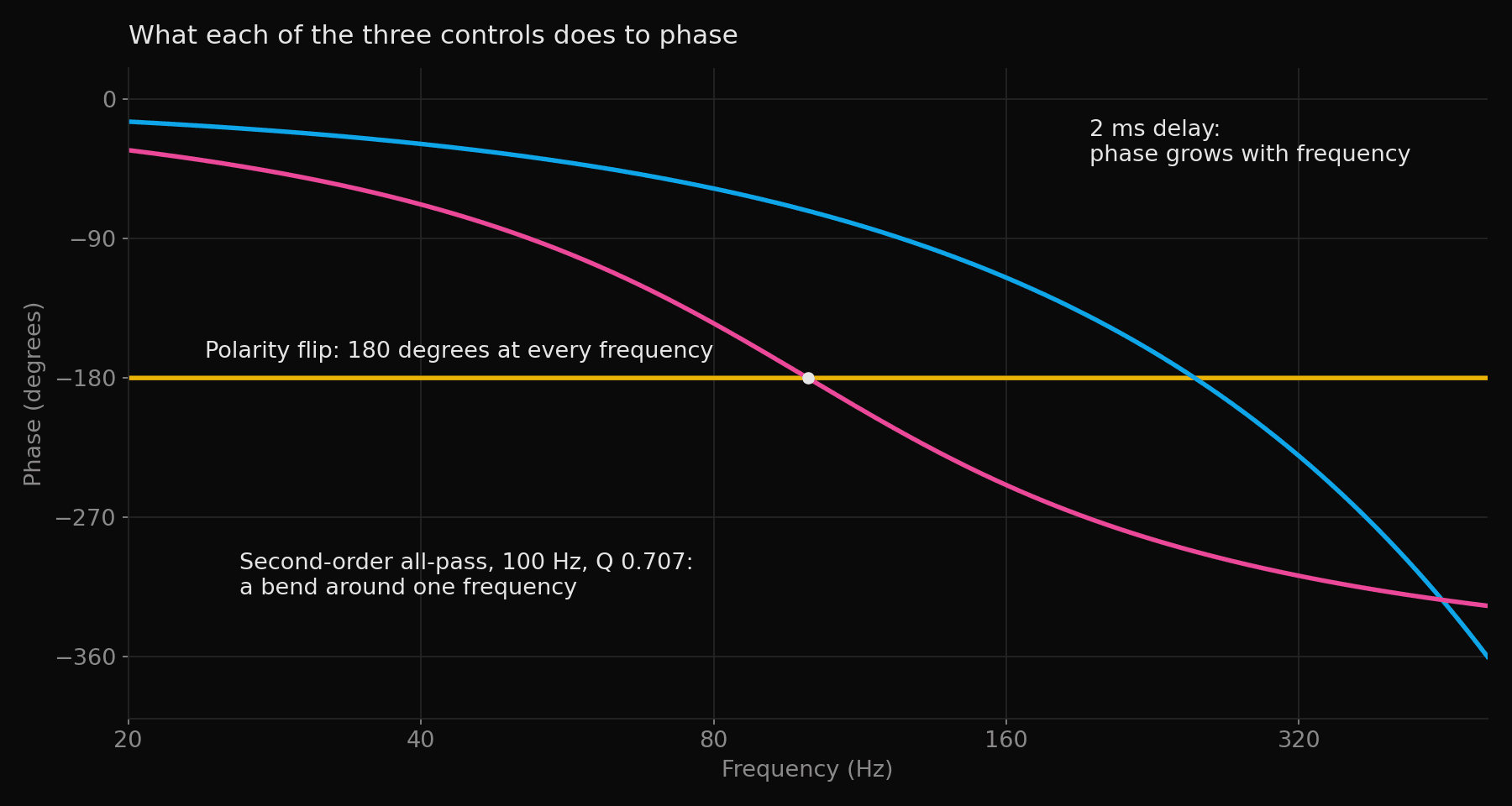
A speaker processor or subwoofer gives you three ways to move phase, and they do different things. A polarity flip shifts every frequency by 180 degrees. A delay shifts high frequencies by more degrees than low ones, in a straight line. An all-pass bends phase around one frequency and leaves level alone. Which one fixes a sub that arrives late depends on how the two speakers overlap. When a delay is needed it goes to the earlier speaker, because delay can only be added. Through an 80 Hz crossover, a flip can stand in for a delay about 5.5 ms shorter at a cost of about 1 dB.
Three Controls, Three Shapes
A polarity flip turns the signal upside down. Every frequency moves by 180 degrees, so the phase trace is a flat line and the group delay is zero.
A delay moves each frequency by an amount that depends on the frequency. The phase shift in degrees is 360 times the frequency times the delay. A 2 ms delay shifts 125 Hz by 90 degrees, 250 Hz by 180 degrees and 500 Hz by 360 degrees. The phase trace is a straight line on a linear axis, and the group delay is a constant 2 ms.
An all-pass filter bends the phase around one chosen frequency and leaves the level untouched. A second-order all-pass lags by 180 degrees at its own frequency and settles towards 360 degrees of lag. Its group delay is spread around that frequency, flat below it at Q 0.707 and a narrow hump at higher Q, which makes it suited to adjusting phase near a crossover.
The three can match at a single frequency. A flip and a delay of half a period both give 180 degrees at that frequency, and a flip and a 100 Hz all-pass both give 180 at 100 Hz. Everywhere else they differ. Choosing between them means looking at the whole band the two speakers share.
What a Sub's Phase Dial Does
Many subwoofers carry a continuous phase control next to the polarity switch. How a given product implements its phase control varies, and the manual or a measurement shows whether it acts around one frequency or across the band like a delay. Set to 180 degrees, a dial that acts around one frequency matches a polarity flip at that frequency only.
Which Speaker Gets the Delay
The earlier speaker gets the delay. A delay can only be added, so the way to bring two speakers together is to hold the one that arrives first until the other catches up. Sound travels at 343 m/s, so each metre of extra path is 2.9 ms. A sub one metre further from you than the mains arrives 2.9 ms late, and the mains need 2.9 ms of delay.
Delaying the sub that is already late makes the gap bigger. Through an ideal 4th-order 80 Hz crossover, a sub 2 ms late leaves a worst dip of 1.5 dB. At 2.9 ms the dip is 3.2 dB. At 4 ms it is 6.5 dB and at 5 ms it is 11.7 dB. A sub 2 ms late that is then given another 2 ms of delay is 4 ms late and leaves the 6.5 dB hole.
Re-measure after the change. Measured with the mains, the sub's phase trace should converge on theirs. If it moves further away, the delay went to the wrong speaker.
The Ladder of Equivalent Delays
At the crossover, a delay of half a period plus a polarity flip changes the phase by the same amount as no change at all. So the aligned setting is one rung of a ladder, and the other rungs are alternatives that agree with it around the crossover. Nearest rungs alternate polarity. They do not sit at exact half-periods of 80 Hz, which would be 6.25 ms and 12.5 ms. The match has to hold across the whole overlap, and a delay's phase error grows with frequency, so the best compromise sits nearer 90 Hz.
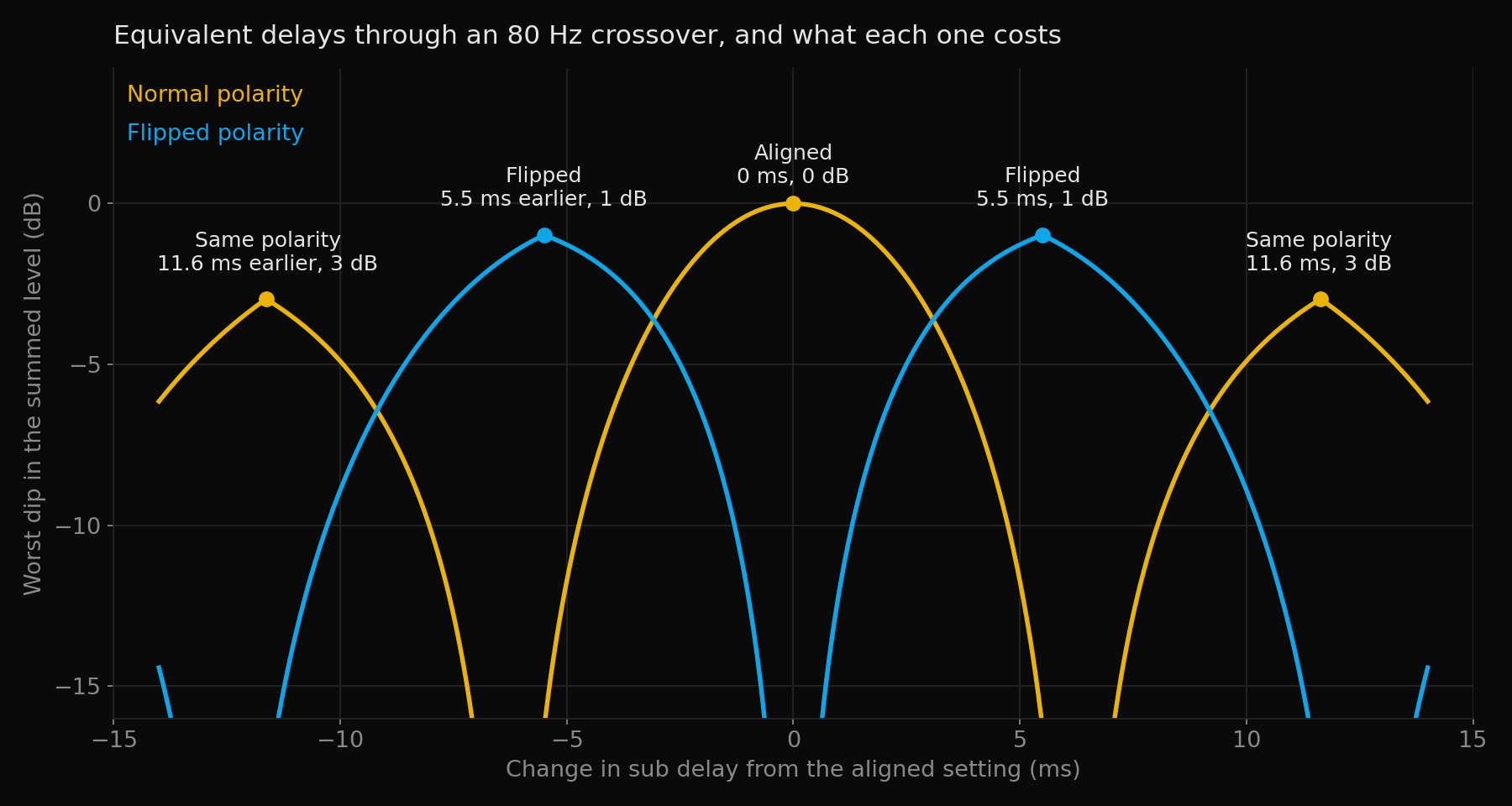
The nearest flipped rung is about 5.5 ms away and costs about 1 dB at its worst frequency. The nearest same-polarity rung is about 11.6 ms away and costs about 3 dB. The cost rises as you go out because the match is exact only at one frequency, and the overlap is wider than that.
A shorter delay can therefore be the better setting. If the exact alignment needs 8 ms, a flipped sub at about 2.5 ms gives up about 1 dB at the worst frequency and saves about 5.5 ms of added latency. Whether 1 dB is worth 5.5 ms depends on the latency limit of the signal path.
Aligned means the phases agree across the band the two speakers share. The impulses need not coincide, and a shorter equivalent rung still sums to within about 1 dB even though they no longer do.
What an All-Pass Can and Cannot Do
An all-pass leaves the level alone and bends the phase, so it can trim the phase difference between two speakers around the crossover without changing the response of either. Its group delay is zero or positive at every frequency, so it can only hold a region back, never pull it forward.
That is the same limit as the delay rule above, and it is the reason flattening a sealed box rolling off at 50 Hz takes about 79 all-pass sections. The proof is in Where the Latency in Linear-Phase Room Correction Comes From.
Common Misconceptions
Flipping polarity is the same as delaying by half a cycle.
A flip is 180 degrees at every frequency. A half-cycle delay is 180 degrees at one frequency and a different angle at every other. The two agree only where the delay happens to be half a period.
A delay shifts every frequency's phase by the same amount.
The shift grows with frequency. A 2 ms delay is 90 degrees at 125 Hz, 180 degrees at 250 Hz and 360 degrees at 500 Hz. Only the delay in milliseconds is the same everywhere.
A sub's phase dial is a polarity switch with more positions.
A sub's phase dial may act around one frequency or across the band, depending on the product. A polarity switch flips every frequency.
A sub that arrives late should be given more delay to line it up.
Delay can only be added, so the earlier speaker is the one that waits. Delaying the late sub widens the gap, and a sub 2 ms late given another 2 ms leaves a 6.5 dB hole at an 80 Hz crossover.
An all-pass filter changes only phase, so it costs nothing.
It leaves level alone and adds group delay around its frequency, never less than zero. Every all-pass section delays the frequencies around its corner, and that delay is latency.
Frequently Asked Questions
Should I flip polarity or add delay?
Measure the sub and the mains together and see which setting makes them add around the crossover. A flip can substitute for a delay about 5.5 ms shorter through an 80 Hz crossover, at a cost of about 1 dB. The choice depends on the crossover and on how much latency you can afford.
Is a polarity flip the same as a 180 degree phase shift?
At every frequency, yes. A flip shifts all frequencies by 180 degrees together. A 180 degree shift from a delay or an all-pass applies at one frequency only, so the two behave differently across a crossover band.
Which speaker do I delay?
The one that arrives first. Delay can only be added, so the earlier speaker waits for the later one. Each metre of extra path on the later speaker is 2.9 ms. The rule holds for any pair of speakers sharing a band, though real systems add driver and filter delays on top of the distance.
What does a sub's phase control actually do?
A sub's phase control shifts phase around one frequency, unlike polarity or delay. How a given product implements the control varies, so check the sub's manual or measure the result before assuming the control behaves like a delay across the band.
What happens if I delay the speaker that is already late?
The gap widens. Through an 80 Hz crossover a sub 2.9 ms late leaves a 3.2 dB dip, 4 ms leaves 6.5 dB and 5 ms leaves 11.7 dB.
Why do several different delays seem to work equally well?
Around the crossover a delay of half a period plus a flip changes phase by the same amount as no change. Through 80 Hz those equivalent settings are about 5.5 ms and 11.6 ms away, with costs of about 1 dB and 3 dB at the worst frequency. They agree at one frequency and drift apart elsewhere.
Does an all-pass filter change the sound?
It leaves the level alone and adds group delay around its frequency. Between two speakers that share a band that changes how they sum, and whether it helps depends on measuring them together.
Conclusion
Use a flip when the sub and mains are about half a period apart at the crossover. Use a delay on the earlier speaker when the gap is a matter of distance, at 2.9 ms per metre. Use an all-pass or a phase dial to trim the phase difference left around one frequency. Check the result with the speakers measured together, because each control matches at one frequency and diverges at others. These figures are from an ideal 80 Hz crossover. Real drivers and a real room will move the exact figures.
Glossary
- Polarity
- The sign of the signal. Inverting it shifts every frequency by 180 degrees.
- Delay
- A time shift. Phase shift in degrees is 360 times the frequency times the delay.
- All-pass filter
- A filter that leaves level unchanged and bends phase around a chosen frequency. Its group delay is never negative.
- Rung
- One of the settings, a delay with a particular polarity, that agree on phase at the crossover. The aligned setting is one rung.
Sign up to hear more when we release something new


