


Where the Latency in Linear-Phase Room Correction Comes From
Flattening the group delay of a speaker takes a filter that delays every frequency to match the latest one, because a filter cannot respond before its input arrives. Two kinds of FIR filter do this job and they cost latency in different ways. A phase-inverse filter for an 80 Hz crossover needs 19 ms, a sealed box rolling off at 50 Hz needs 31 ms and a ported box at 35 Hz needs 82 ms. A symmetric linear-phase EQ filter needs half its own length, set by the lowest frequency it must resolve. An all-pass cannot substitute for either at the bass without dozens to hundreds of sections (79 for a sealed box at 50 Hz, 400 for a ported sub with an 80 Hz crossover).
No Real-Time Filter Can Make Late Bass Arrive Early
A real filter produces output only after input arrives. If a speaker's bass arrives 5 ms later than its midrange, a corrector cannot pull the bass earlier. The only option is to hold the midrange back by 5 ms so the bass catches up. The flattened result is as late as the latest frequency it contains.
The cost of flattening group delay therefore scales with the delay being removed. An ideal 4th-order Linkwitz-Riley crossover at 80 Hz has about 5.6 ms of group delay at low frequencies. Removing it needs at least that much latency, and the filters that do it need more, as the next section shows.
Two Kinds of FIR Filter
Two different filters get called linear-phase, and their latencies have different causes.
A phase-inverse FIR
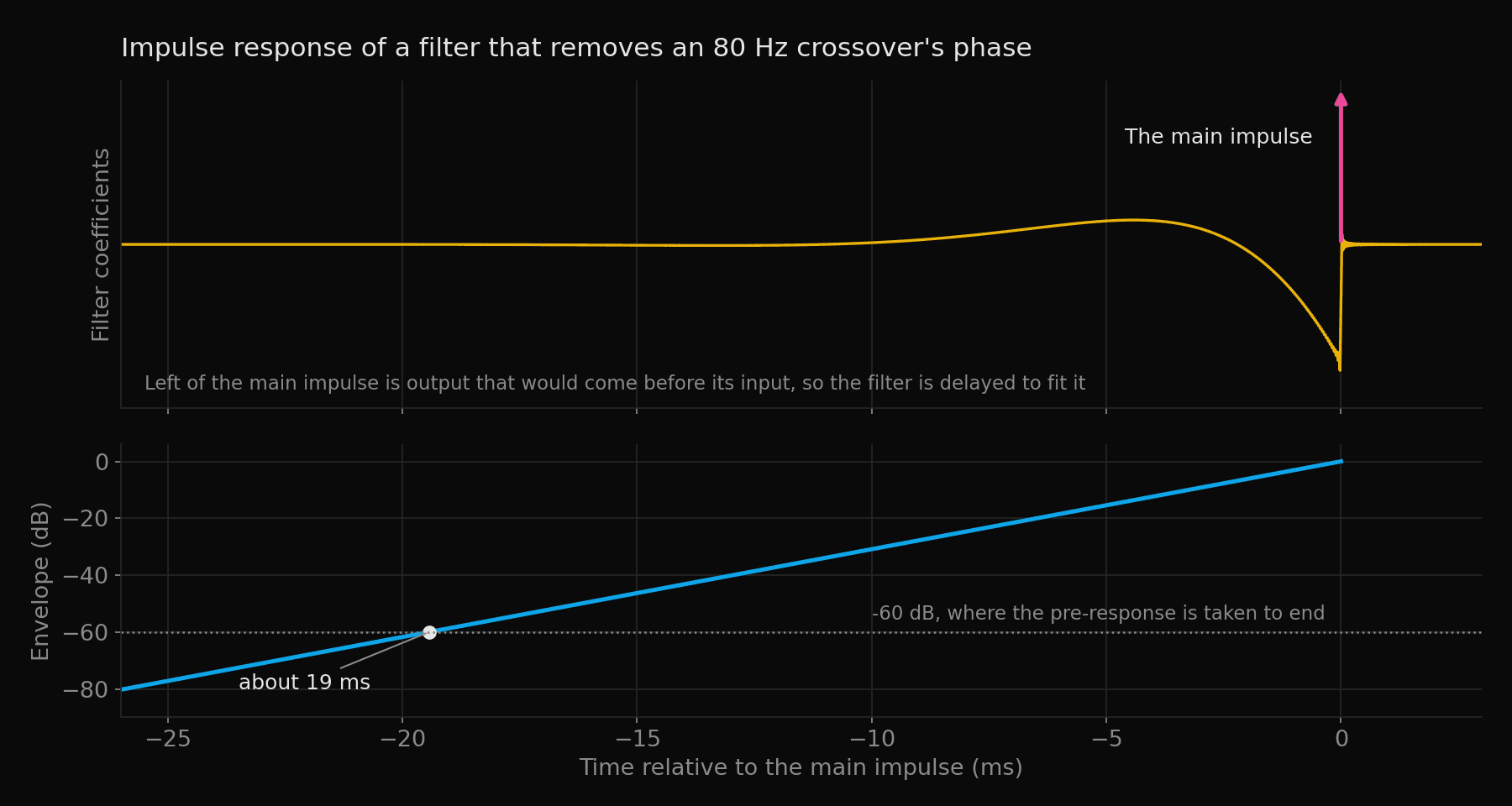
A phase-inverse FIR undoes a known phase response, such as a crossover or a box roll-off. Its impulse response is the time reverse of the response it undoes, so its energy sits before the main impulse. To make it causal the whole filter is delayed until the last of that early energy has come through. Its latency is its pre-response length.
| Case | Latency |
|---|---|
| LR4 crossover at 2 kHz | 0.8 ms |
| LR4 crossover at 300 Hz | 5.2 ms |
| LR4 crossover at 80 Hz | 19 ms |
| Sealed box, 50 Hz roll-off, made linear phase | 31 ms |
| Ported box, 35 Hz roll-off, made linear phase | 82 ms |
These are pre-response lengths, the point where the early tail has fallen 60 dB. The cost rises as the corner falls. The same filter that costs 0.8 ms at 2 kHz costs 19 ms at 80 Hz, and a ported box, which carries a 4th-order roll-off at 35 Hz in the model, costs 82 ms. The side effect of that early energy is pre-ringing, covered in Linear-Phase Room Correction: The Trade-Offs.
A symmetric linear-phase EQ FIR
A symmetric linear-phase EQ FIR shapes level, a boost or a cut, without changing phase. Its impulse response is symmetric about its centre, which is why its phase is linear, and its latency is half its length. The length is set by how finely it must resolve the lowest frequency it touches. A filter N samples long resolves features roughly fs divided by N wide. At 48 kHz, a resolution of 10 Hz takes 4800 samples, which is about 50 ms of latency.
The two filters share the name linear phase and constant delay across frequency, and their latencies have different causes. The table above is the first kind. Half a filter's length is the second kind. Applying the half-length rule to a phase-inverse filter gives the wrong latency.
How Many All-Pass Sections a Speaker Needs
An IIR all-pass section changes phase without changing level, and four of them added 1.3 to 2.7 ms in the study, so it looks like a low-latency alternative. A numerical study of this question found two exact results that rule all-pass sections out for the bass.
The first is that a stable all-pass section has group delay greater than or equal to zero at every frequency. Equalising with all-pass sections can only lift the low-delay regions up towards the highest one. It cannot pull the high region down.
The second is that the area under group delay against frequency is fixed. Every second-order section encloses exactly 1 ms times kHz, whatever its frequency and Q. A tall narrow section and a low wide one hold the same area. To lift a band B kHz wide by D ms, the sections must enclose D times B in total, so at least D times B of them are needed.
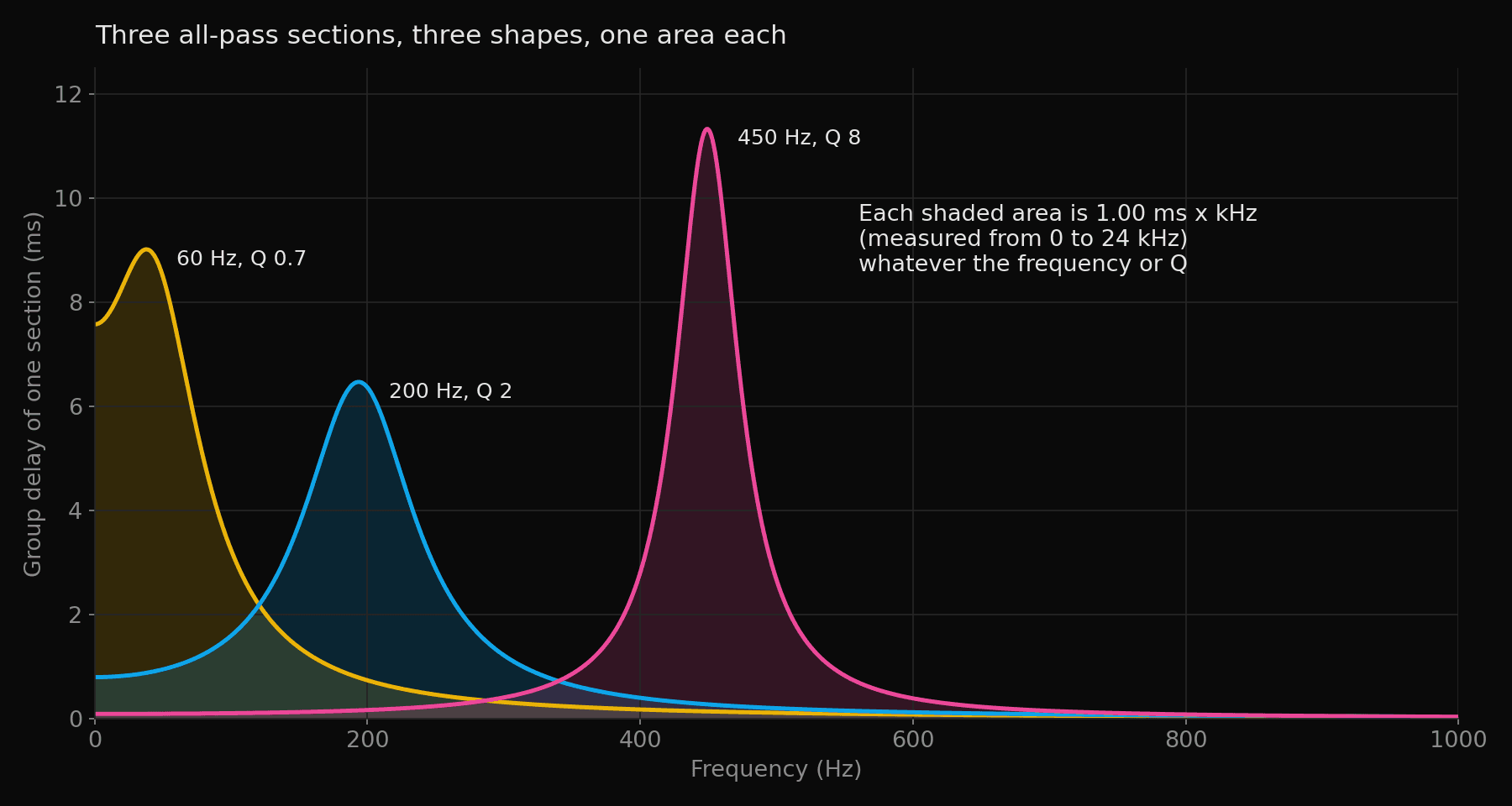
| Case | Delay to lift | Band | Sections needed |
|---|---|---|---|
| Two-way crossover bump at 2 kHz | 0.2 ms | About 2 kHz | 0.4, so feasible |
| Sealed box rolling off at 50 Hz | About 5 ms | About 16 kHz | 79 |
| Ported sub plus an 80 Hz crossover | 25 ms | About 16 kHz | 400 |
The band is wide because the delay sits at the bottom of the range. To flatten it, everything above has to be lifted to match. The study measured the delay and band exactly, so its counts differ slightly from the rounded figures in the table. The mid crossover is the only case an all-pass handles, and it was already at about 0.2 ms against a threshold of about 1 ms.
Optimising up to four sections against the Blauert and Laws thresholds moved the ported two-way from 4.23 times the threshold to 3.76, with the threshold held at 3.2 ms below 500 Hz. The low-frequency rise needs 79 to 400 sections to equalise with IIR, and an FIR can only remove it at tens of milliseconds plus pre-ringing.
What to Do Instead: Match the Speakers to Each Other
Flattening one speaker needs all-pass sections to lift the whole band to the level of the bass delay. Matching two speakers needs 0.2 of one section. Where a sub and the mains overlap, the phase difference between them across that octave or so determines whether they add or cancel. The speaker whose phase leads, the early one, can take an all-pass that lags its phase until the two agree.
The delay-area rule from the previous section sets the count. The band to lift is about 100 Hz wide, not 16 kHz, so lifting it by 2 ms is 0.1 kHz times 2 ms, which is 0.2 of one section. A single second-order all-pass is enough.
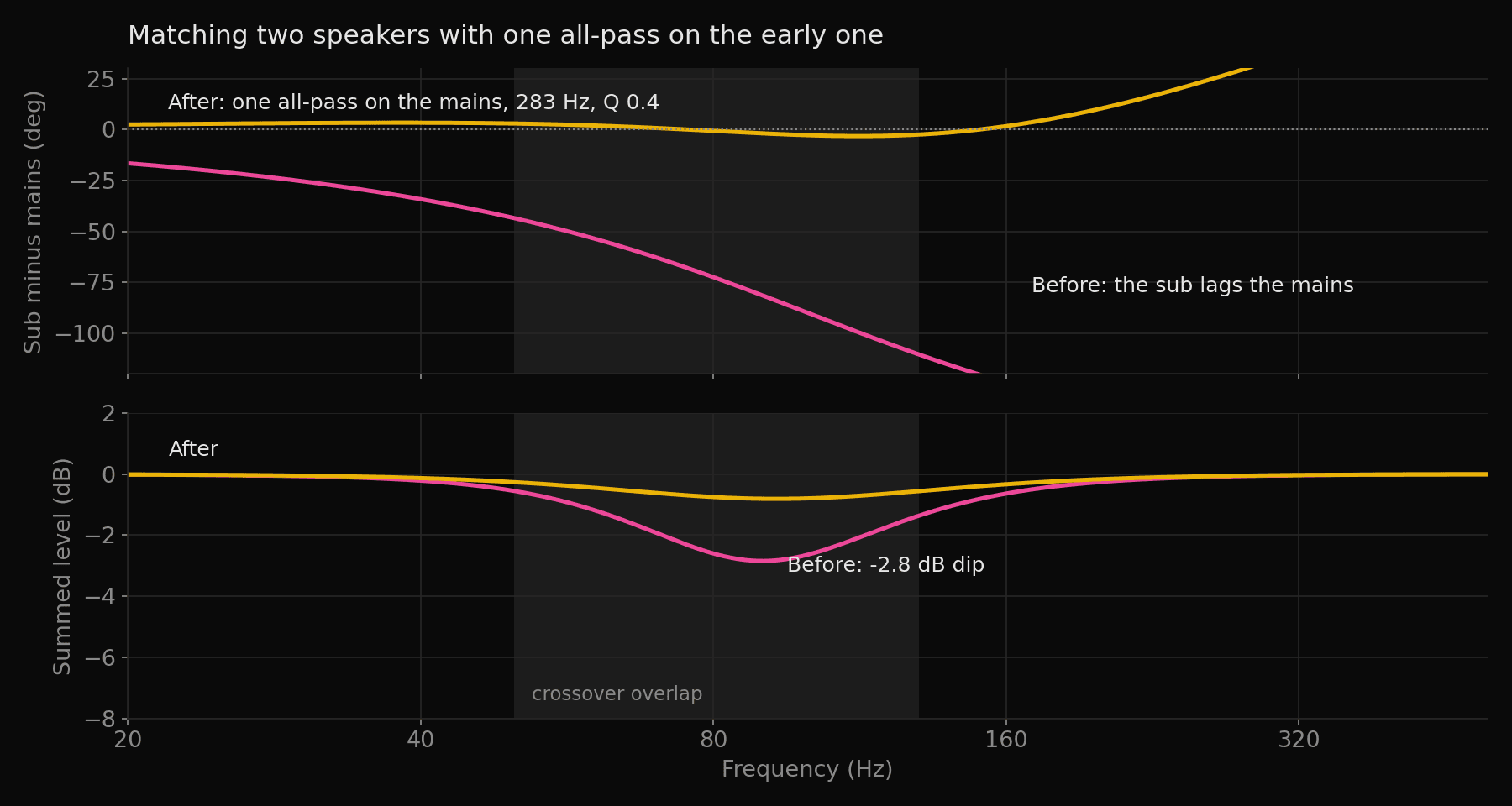
In the model the sub trails the mains by up to 110 degrees across the overlap, and the sum dips 2.8 dB. One all-pass on the mains brings the difference to within 3 degrees and the dip to 0.8 dB. The remaining 0.8 dB is the sub's own level falling away above its roll-off: adding the two levels with no phase difference at all also gives a 0.8 dB dip.
The cost is latency on the mains only, about 2.2 ms around 80 Hz in this model, and close to none in the midrange and treble. The all-pass adds a few milliseconds in the band where the two speakers overlap, against the tens of milliseconds a phase-inverse FIR adds to the whole signal.
Omnissiah's Phase Correction fits this all-pass after delay and polarity are set. A genetic algorithm searches all-pass filter frequencies and Q values, with corners at or below 1.5 kHz, for the set that minimises the phase error between each speaker and the reference through the band they share. Phase Correction is off by default and makes calibration take longer.
What Latency Costs You
Latency adds the same delay to every frequency, so playback you only listen to sounds the same, shifted as a whole. It matters in two cases. The first is anything you play or sing into while listening back through the processor, which arrives late by the full amount. The second is sound that has to stay in step with something else, such as picture.
There is no single millisecond figure that is safe for everyone, because the tolerable delay depends on the instrument, the monitoring route and the player. The practical question is whether the processor sits in the path you perform through. If it does, the extra delay of a linear-phase mode is part of every note you hear back.
Published latency figures for room correction products vary widely. IK Multimedia lists ARC Studio at 42 ms in its linear-phase mode. The miniDSP Flex with Dirac is listed at about 12 ms, and the Trinnov Nova at about 25 ms with optimisation. NEXUS lists 0.85 ms from analog in to analog out, plus any alignment delay on the outputs that receive it. These are each product's own figures.
Rules of Thumb
Frequently Asked Questions
Why does linear-phase correction add latency?
A filter cannot output before its input arrives. To make every frequency arrive together it has to hold the early ones back until the latest one catches up. The delay is set by how late the latest frequency is, which in a speaker is the bass.
How much latency does it cost to linearise a crossover?
For a phase-inverse FIR, measured as pre-response to -60 dB, the study gives 0.8 ms at 2 kHz, 5.2 ms at 300 Hz and 19 ms at 80 Hz. Those are ideal LR4 crossovers. A real speaker with offset drivers differs a little, and a cut-off other than -60 dB would change the figures.
Is the latency half the filter length?
For a symmetric linear-phase EQ filter, yes. For a phase-inverse filter, no. Its latency is its pre-response length, which is where the early energy ends. The two share the label linear phase, and their latencies have different causes.
Can an all-pass filter flatten group delay instead?
Only where the delay times the band is under about one section, as at a 2 kHz crossover (0.4). Every second-order section encloses the same fixed area, so lifting a band of B kHz by D ms takes at least D times B sections. A 2 kHz crossover bump needs 0.4. A sealed 50 Hz box needs 79 and a ported sub with an 80 Hz crossover needs 400.
Does latency matter if I only mix?
Playback alone is shifted as a whole and sounds the same. It matters when you play or sing through the processor, or when the sound must stay in step with picture or another source. There is no figure that suits everyone.
What latencies do other room correction products list?
ARC Studio lists 42 ms in its linear-phase mode. The miniDSP Flex with Dirac is about 12 ms and the Trinnov Nova about 25 ms optimised. Each is that product's own figure.
Does a longer FIR always mean better correction?
A longer filter resolves lower frequencies more finely and costs more latency, so length follows the lowest frequency you need to shape. Whether the shaping is audible is a separate question, and for group delay in the bass the threshold is disputed.
Conclusion
Choose the filter by the group delay to be removed and the latency you can accept. A midrange crossover costs under 1 ms to linearise, and its delay is about 0.2 ms against a threshold of about 1 ms. An 80 Hz crossover costs 19 ms, and a ported box at 35 Hz costs 82 ms. A symmetric EQ filter costs half its length, which grows as the lowest frequency falls. An all-pass will not substitute at the bass, because it cannot pull delay down and each section holds a fixed area. If you perform through the processor, budget the latency before turning on a linear-phase mode. The figures here are from ideal models. A measured system will differ in detail.
Glossary
- Pre-response
- The part of a filter's impulse response that comes before its main impulse. A causal implementation must be delayed by this length.
- Phase-inverse FIR
- A filter whose response is the conjugate of a known phase response. Its latency is its pre-response length.
- Symmetric linear-phase FIR
- A filter symmetric about its centre, with constant delay across frequency. Its latency is half its length.
- All-pass section
- A filter that leaves level unchanged and bends phase. Its group delay is never negative, and each second-order section encloses a fixed area.
Sign up to hear more when we release something new


