



Phase Correction: Three Things It Can Mean, and Which One You Can Hear
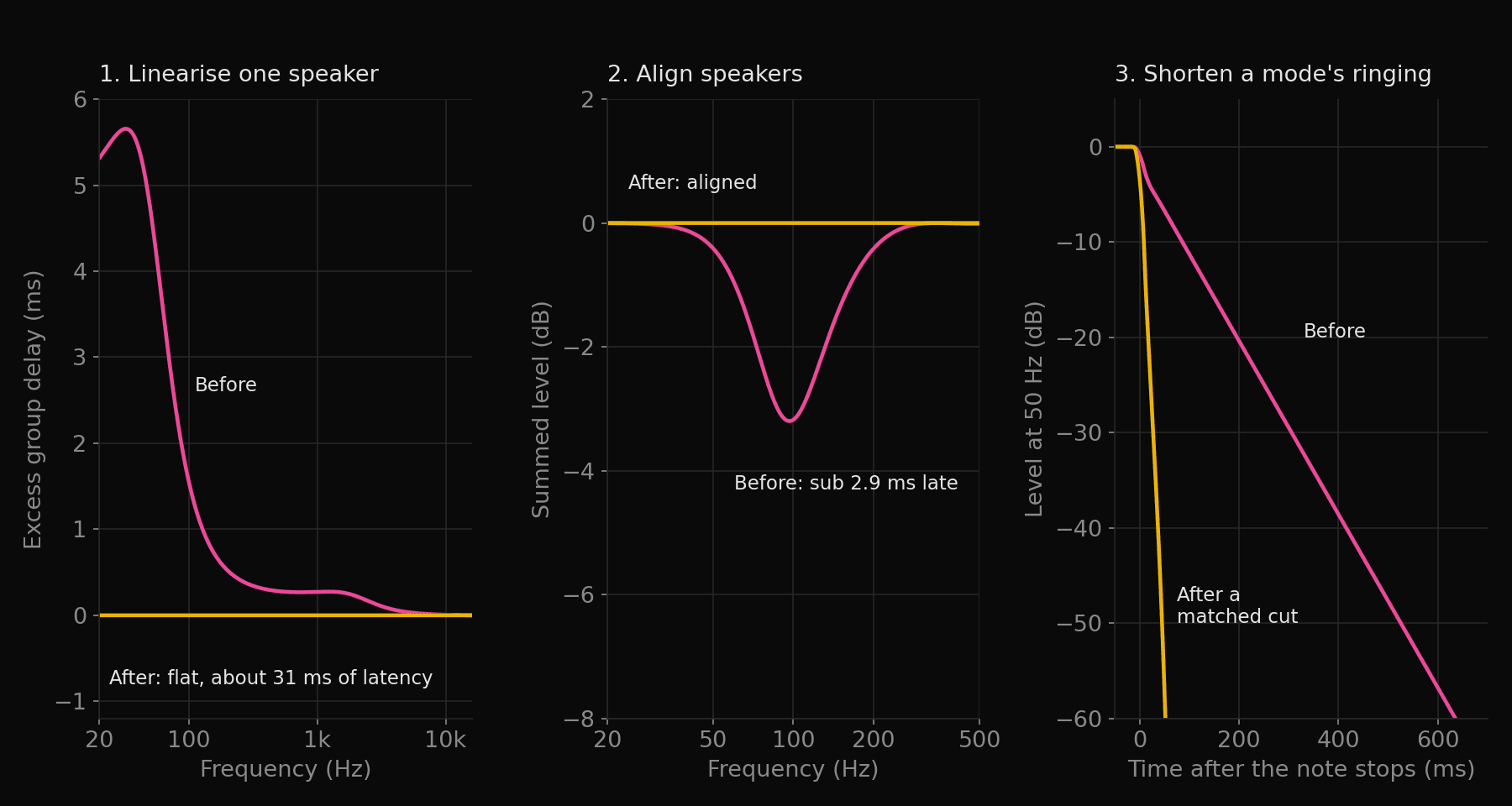
Phase correction names three different jobs. Linearising one speaker flattens its group delay, which is about 0.2 ms at a 2 kHz crossover against a detection threshold of about 1 ms, and costs 19 to 82 ms of latency in the bass. Aligning speakers to each other stops a sub and its mains cancelling across the crossover, which is audible as a dip, 3.2 dB for a sub 2.9 ms late at 80 Hz, and costs a few milliseconds of delay on the earlier speakers. Shortening modal decay uses a cut matched to a room mode so its tail dies sooner, at every seat, when the match is close. The spec sheet is the place to look for which one a product does.
One Terminology Can Mean Three Different Things
Spec sheets, reviews and forum threads all say phase correction, and they mean three different things. The three jobs differ in mechanism, in cost and in whether you can hear the result. A product can do one of them well and skip the other two under the same label.
The second job costs a few milliseconds of delay, 2.9 ms per metre of path difference. The third shows only on a decay plot. The first costs 19 to 82 ms in the bass and removes about 0.2 ms at a 2 kHz crossover against a threshold of about 1 ms.
| Meaning | What it changes | Who usually means it | Can you hear it | Sign on a spec sheet |
|---|---|---|---|---|
| 1. Linearise one speaker | Flattens one speaker's group delay so every frequency leaves it together | Studio FIR correction products | At a 2 kHz crossover, no: about 0.2 ms against a threshold of about 1 ms. In the bass, disputed | A latency in tens of milliseconds, often for a named linear-phase mode, or a filter length in taps |
| 2. Align speakers to each other | Delay, polarity and all-pass filters, so speakers sharing a band add instead of cancelling | Live-sound measurement tools and the engineers who use them | Yes. A sub 2.9 ms late through an 80 Hz crossover leaves a 3.2 dB dip | Delay per output in milliseconds or metres, a maximum delay, and a polarity setting per output |
| 3. Shorten modal decay | A cut matched to a room mode, so its ringing dies sooner | REW and hi-fi users, through waterfall plots | The modelled mode below takes about 640 ms to fall 60 dB after the note stops. No study in this series measures when that becomes audible | Decay or waterfall plots measured at the seat, before and after. An impulse plot on its own does not show it |
Marketing that says time domain correction usually reads as the first or the third. Time alignment means the second. Some full correction suites, Trinnov and Dirac's Bass Control among them, also do the second, so check the spec sheet rather than the product category.
What Arriving Together Means
A steady 100 Hz tone has no arrival point. Every cycle looks like the last, so delaying it by one period changes nothing. A kick drum's onset does have one, and what changes is the envelope: the rise and fall of the sound's overall level, which spans many cycles in the bass.
Two speakers arrive together when, across the band they share, their envelopes rise at the same time and their phases agree, so they add. A sub's impulse is a slow swell, and its arrival is the peak of that swell. Through a narrow crossover there is a ladder of other delays that also add, with the polarity flipped on alternate rungs and a summation cost that grows with each rung (about 1 dB for the nearest, about 3 dB for the next at 80 Hz). Polarity, Phase and Delay Are Not the Same Knob covers which rung to take.
- Group delay
- How late each frequency arrives, read from the slope of the phase against frequency. If it is the same at every frequency, the system is a pure delay.
Flat Phase Is an Arbitrary Target
Phase measured at a seat is mostly flight time. Each metre between speaker and microphone adds 2.9 ms, and a pure delay of any length is inaudible, so whether a phase trace is flat depends on where the software starts counting time. The target with any meaning is constant group delay once that bulk delay is removed, and reaching it is meaning 1.
Against the Blauert and Laws (1978) thresholds, a 2 kHz crossover adds about 0.2 ms against a threshold of about 1 ms. The larger delays, about 5 ms for a sealed box rolling off at 50 Hz and 15 to 20 ms for a ported box at 35 Hz, sit below 500 Hz, where the threshold is disputed.
What Linearising One Speaker Costs and Removes
No real-time filter can make late bass arrive early, so a linearising filter holds back everything above the bass until the bass catches up. A phase-inverse FIR does this at a latency that grows as frequency falls, with a pre-response to -60 dB of 0.8 ms for a 2 kHz crossover, 19 ms for an 80 Hz sub crossover, 31 ms for a sealed box at 50 Hz and 82 ms for a ported box at 35 Hz. An all-pass filter can only add delay, and each section adds a fixed total amount of it, so flattening a sealed box at 50 Hz takes about 79 sections against the 15 filters NEXUS has per output.
A modelled sealed two-way is 0.10 times the threshold from 200 Hz up, and 0.14 to 1.29 times including its bass, depending on which reading of the bass threshold you take. A ported two-way is 0.36 to 4.23 times. Removing the bass delay carries a latency you pay every time you track through the system.
Room reflections set a second limit. Above 1 to 2 kHz a 5 cm head movement changes a path's phase by 105 degrees at 2 kHz, so a filter that inverts that phase at the microphone does not hold a head's width away.
Aligning Speakers Is the Job You Can Hear
When a sub and its mains share the octave around an 80 Hz crossover, the sound at your seat is their sum. If the sub arrives late, the two drift out of phase across that octave and partly cancel. Through an ideal 4th-order Linkwitz-Riley crossover, a sub 2 ms late costs 1.5 dB at the worst point, 2.9 ms costs 3.2 dB and 5 ms costs 11.7 dB. One metre of extra path is 2.9 ms.
A crossover cancellation is a broad dip, about an octave wide. Bücklein (1981) found broad response deviations audible at about 1 to 2 dB and narrow ones from about 3 to 5 dB, with dips harder to hear than peaks of the same size. A 3.2 dB dip an octave wide sits above that broad figure, though 80 Hz lies below the bands Bücklein found most sensitive, 200 to 600 Hz and 2 to 6 kHz.
The fix is delay on the speaker that arrives first, so it waits for the late one, plus a polarity choice per output. An all-pass filter through the crossover can reduce the phase difference left after delay and polarity are set. The cost is the alignment delay itself, on the outputs that receive it.
For a matched stereo pair, each speaker's own excess phase is the same on both sides, so what alignment works on is the difference the room adds. Below about 500 Hz that difference survives head movements of a few centimetres. Above 1 to 2 kHz a 5 cm move changes it by 105 degrees at 2 kHz, which is why Omnissiah keeps its all-pass corners at or below 1.5 kHz.
Modal Decay: What a Matched Cut Does
A room mode is a resonance of the air in the room at a frequency set by its dimensions. At the seat it shows as a peak in level and, in time, as a tail that keeps ringing after the note stops. In the model below, a 50 Hz mode with a +12 dB peak takes about 640 ms to fall 60 dB.
A minimum-phase cut matched to the mode cancels the mode's pole, so the tail shortens along with the peak. In the same model an ideal matched cut brings the 60 dB decay down to about 50 ms, which is the rest of the system's own response. A mode's frequency and decay are the same everywhere in the room, so a matched cut shortens the tail at every seat. Its level is right only at the seat you measured, because the height of the mode's peak changes with position.
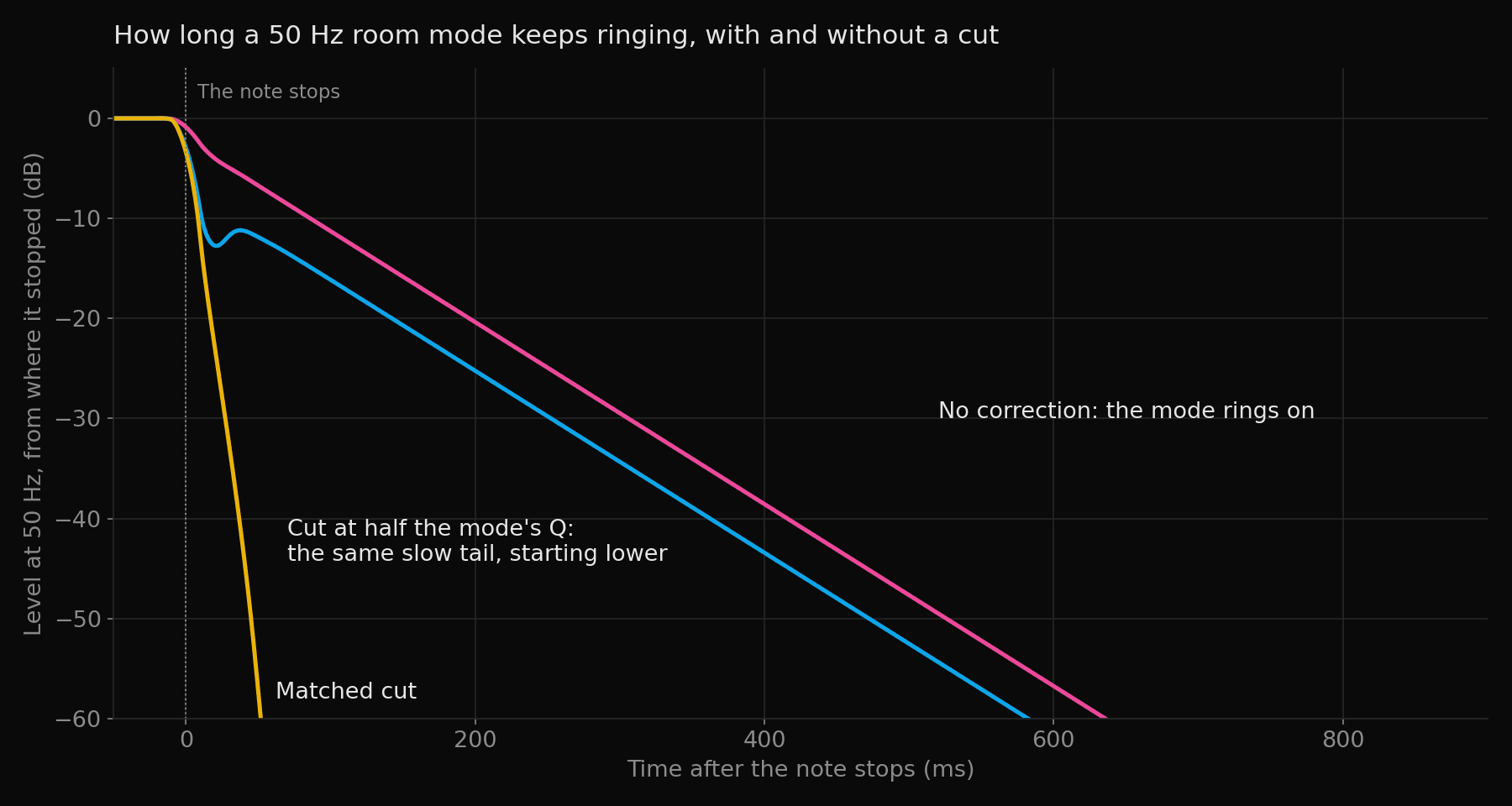
The match has to be close. A cut at the right frequency and depth with half the mode's Q leaves the mode's pole in place, so the tail falls at the same slow rate from a lower start and reaches -60 dB at about 580 ms. Both cuts bring the level at 50 Hz down by the same amount, so a level reading at the mode's frequency cannot tell you which one you have. The mode in this model has a Q of 15, so a matched cut needs a Q of 15 as well.
To check a claim, ask for a decay plot or spectrogram at the seat, before and after, at the same level. An impulse plot from a windowed measurement cuts off the tail before it can show any decay. Without a decay plot, a claim about the third job is unverified.
Five Questions to Ask a Product
- 1Does it align speakers to each other, and can you re-measure afterwards to see the result? Alignment is the audible job, and a re-measure is the proof it worked in your room.
- 2What latency does it add with correction active, from input to output? The figure determines whether you can track through it or have to switch it off to play.
- 3Does it linearise single speakers, and if so, at what latency? Once it reaches into the bass, the figure is 19 ms for an 80 Hz crossover and more below it.
- 4Does it show decay, or only level? A decay or spectrogram view at the seat is the way to see whether a mode's tail got shorter.
- 5What does it do above 1 kHz, and why? A 5 cm head move changes a path's phase by 105 degrees at 2 kHz, so a correction that inverts it holds at one head position.
The Five Questions Applied to Omnissiah
Alignment. Omnissiah sets a delay and a polarity for every output from a measurement at the listening position, and the delay goes to the speaker that arrives first. By default the sub is aligned to the mains and the tops are checked for polarity only. Set Time-Align Tops to All speakers and left and right are time-aligned to each other as well. Calibration measures one microphone position by default, and you re-measure after applying to check the result.
Latency. NEXUS runs at 0.85 ms analog in to analog out, plus any alignment delay on the outputs that receive it. Each output holds up to 8.5 ms of delay, about 2.9 m of path.
Single speakers. Omnissiah does not linearise them. Phase Correction, off by default, is an alignment pass that fits all-pass filters with corners at or below 1.5 kHz, so each speaker's phase follows the reference through the band they share. Phase Correction makes calibration take longer.
Decay. Omnissiah has no group delay view and no decay view yet. Its cuts are fitted to correct level, and where one happens to match a mode's frequency and Q it shortens the tail too, but the app neither aims for that nor shows it. The decay figures in this article come from a model.
Above 1 kHz. Phase Correction keeps its filter corners at or below 1.5 kHz, and nothing in Omnissiah inverts the room's phase higher up, because there it changes with every movement of your head.
Common Misconceptions
Linear phase is strictly better.
Linear phase removes a speaker's excess group delay at the cost of latency and pre-ringing. At a 2 kHz crossover the delay removed is about 0.2 ms against a threshold of about 1 ms. In the bass the filter needs 19 to 82 ms, so every note played through it arrives that late.
EQ cannot touch ringing.
A minimum-phase cut matched to a room mode cancels the mode's pole, so the tail shortens along with the peak, at every seat. The match has to be close. A cut with the wrong Q leaves the slow tail in place.
A flat phase trace, or impulses that line up, means the speakers are aligned.
Why You Can't Hear Absolute Phase covers both: phase at a seat is mostly flight time, and a sub's impulse is a slow swell with no sharp arrival.
Frequently Asked Questions
What does phase correction mean?
One of three jobs: linearising one speaker's group delay, aligning speakers to each other with delay and polarity, or shortening a room mode's ringing with a matched cut. Products use the same words for all three, so the spec sheet and the plots are what tell you which one you are buying.
Can you hear phase correction?
Aligning speakers is audible: a sub 2.9 ms late through an 80 Hz crossover leaves a 3.2 dB dip. Linearising a 2 kHz crossover removes about 0.2 ms against a threshold of about 1 ms. Whether the larger group delays in the bass are audible on their own is still disputed.
Do I need linear-phase room correction?
A modelled sealed two-way is 0.14 to 1.29 times the threshold, depending on the bass reading. A ported two-way is 0.36 to 4.23 times, and removing the delay costs up to 82 ms of latency, so every note played through the system arrives that late. The research on audibility in the bass has not settled whether that delay is audible.
Does phase correction add latency?
Alignment adds only the delay given to the earlier speakers, 2.9 ms for each metre of path difference. A phase-inverse FIR that reaches into the bass adds 19 to 82 ms. Ask for the figure with correction active, from input to output, because a product's quoted latency may leave it out.
Can EQ fix room mode ringing?
A minimum-phase cut matched to the mode's frequency, depth and Q cancels its pole and shortens the tail at every seat. Its level is right only at the seat you measured, and a cut with the wrong Q leaves the slow tail in place.
Is time alignment the same as phase correction?
Time alignment is one of the three meanings: delaying speakers, and flipping their polarity where needed, so they add through the band they share. It leaves a single speaker's group delay and a room mode's tail as they were.
How can I tell if phase correction worked?
Re-measure at the seat after applying. Alignment shows as no dip around the crossover. A claim about ringing needs a decay or spectrogram plot before and after, because a level plot at the mode's frequency can look the same either way. One measurement position shows you one seat.
Does Omnissiah do phase correction?
It aligns speakers with a delay and a polarity per output, and an optional Phase Correction pass fits all-pass filters with corners at or below 1.5 kHz. It does not linearise single speakers, and it has no group delay or decay view yet.
Conclusion
Choose a correction by which of the three jobs you need. If your speakers share a band, as a sub and mains do, alignment fixes a cancellation you can measure and hear, for a few milliseconds of delay on the earlier speakers. If a room mode rings, a matched minimum-phase cut shortens it, and a decay plot at the seat is the proof to ask for. Linearising one speaker applies to ported speakers used for playback, where the modelled two-way reaches 4.23 times the threshold if it is held flat below 500 Hz, and every note played through the filter arrives up to 82 ms late. No correction measured at one seat fixes the room's phase above 1 to 2 kHz.
Glossary
- Group delay
- How late each frequency arrives, read from the slope of the phase against frequency.
- Linear phase
- A response with the same group delay at every frequency: a pure delay plus any level shaping.
- All-pass filter
- A filter that changes phase without changing level. It can only add delay.
- Room mode
- A resonance of the air in a room at a frequency set by its dimensions, heard as a peak and a slow tail.
Sign up to hear more when we release something new


