



Aligning More Than Three Speakers
Aligning many speakers means choosing one reference and bringing every channel into agreement with it. The delay goes to the earlier speakers, so the farthest speaker gets none and the whole spread of arrival times has to fit the delay limit of a single output. Each channel is consistent with the reference only in the band it shares with it. When all-pass filters can go on the reference and pairs are fitted one at a time, the pair fitted first shapes the reference for the rest, so fit the pairs with the widest overlap first. Several subwoofers need a separate check of how they sum, and in the example layout a seat 0.5 m from the measured one is up to 2.2 ms out.
One Reference, Every Channel Aligned to It
With two speakers there is a pair to match. With six there are fifteen pairs, and aligning each to each would give contradictory answers. The practical method picks one reference and brings every channel into agreement with that. Since each channel matches the reference, any two channels are consistent through it, within the limit set out below.
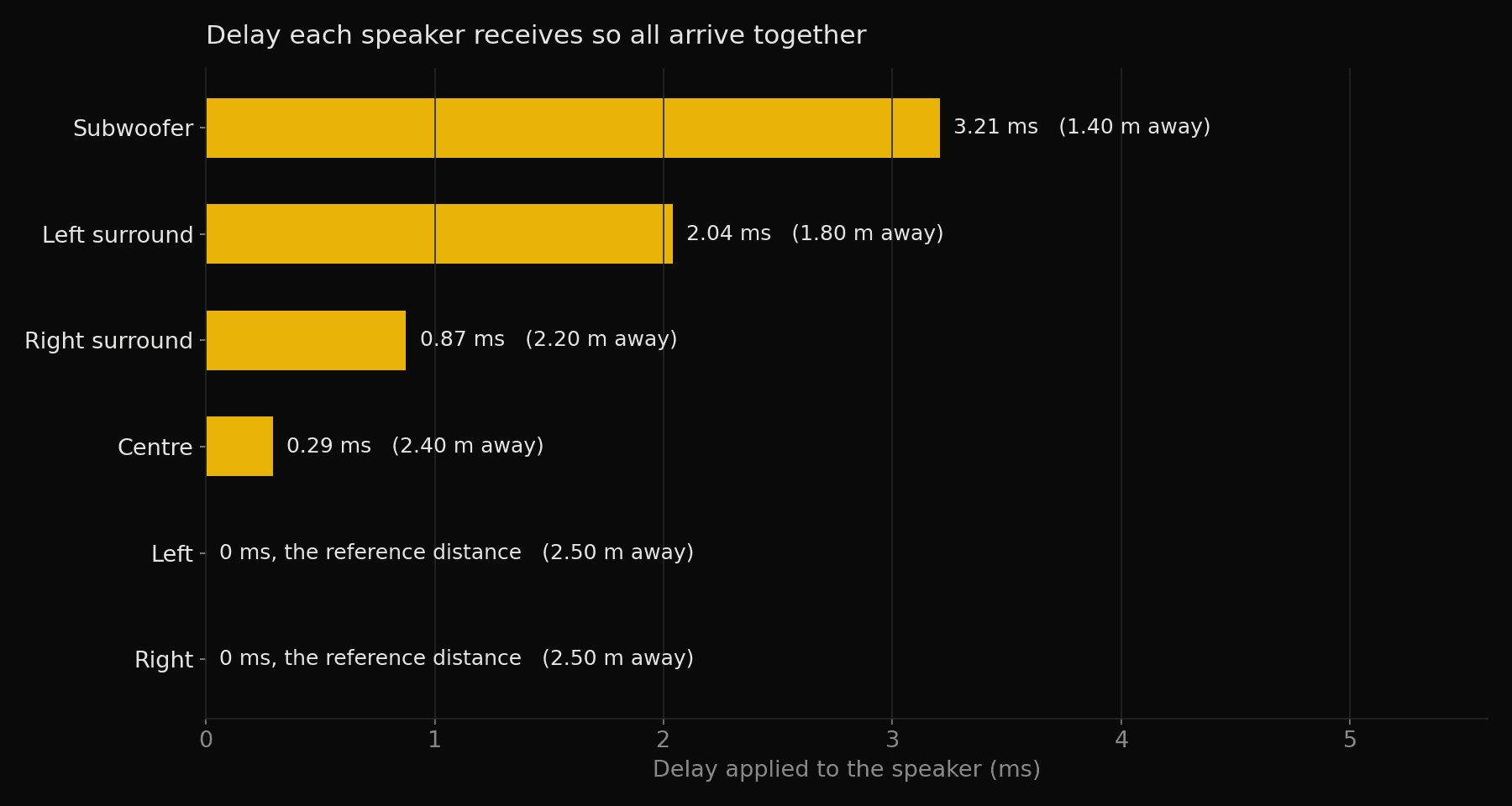
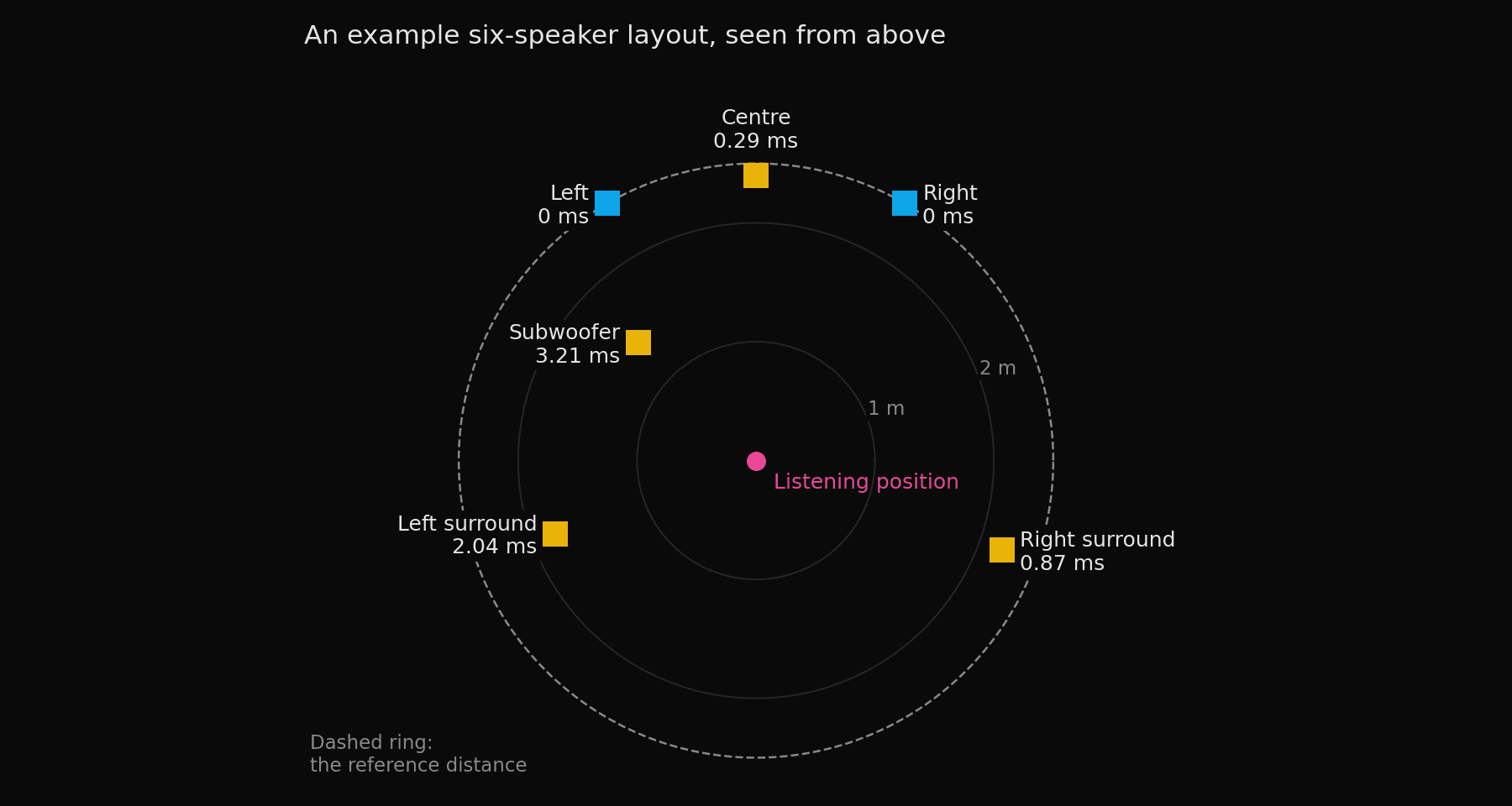
A speaker cannot be made to arrive sooner, so the delay goes to the earlier ones. For speaker i at distance d, the delay is (the largest distance minus d) divided by 343 m/s. The farthest speaker gets zero. In the example at the top of this page the subwoofer is 1.10 m nearer than the farthest speakers and receives 3.21 ms, the left surround receives 2.04 ms and left and right receive none.
The Spread Must Fit the Delay Limit
Each output has a maximum delay. The largest delay any speaker needs is the spread between the farthest and the nearest, which is 1.10 m or 3.21 ms in the example. If the spread exceeds the limit, the nearest speakers cannot be aligned to the farthest. The remedies are to move the nearest speaker back or to accept a partial alignment.
Processors differ in how much delay they allow per output, so check the processor's specification against the spread you measure. Work in metres first, since each metre of spread is 2.9 ms, and compare that figure with the limit.
The Order You Fit Pairs In
Phase can be matched with all-pass filters, which add delay that varies with frequency. In tools that may put all-pass filters on the reference as well as on the other channel, the reference has a fixed number of filters. When the pairs are fitted one after another against a shared reference, the first pair can use the reference's filters for its own best fit. Every later pair is then fitted against a reference that has already been reshaped for the first pair.
The result is order-dependent. In a probe of Omnissiah's fit, with the sub pair first the sub's residual fell from 44 to 3 degrees and the tops' from 64 to 61. With the tops first, the tops fell from 64 to 4 degrees and the sub from 44 to 23.
Fit the pair with the widest overlap first. A stereo pair of tops shares the whole range above the crossover, so a phase error there is audible across a wide band. A sub shares only a narrow band around the crossover, so there is less to lose by fitting it second. If your tools let you set the order, put the tops before the subwoofer.
More Than One Subwoofer
Each sub aligned to the tops through the crossover can land on a different rung of the ladder, a different delay or a different polarity, each with its own small summation cost. The article on polarity, phase and delay covers those equivalent choices. Two subs that each match the tops well can still differ in phase from each other.
Check the subs' sum below the crossover on its own. Two subs whose delays differ by 12.5 ms cancel at 40 Hz, because 12.5 ms is half a period there, and a gap of 5.5 ms cancels at 91 Hz. Measure the subs together with the tops silent and look for a dip. One order is to align the subs to each other first and then align the pair of subs to the tops.
One Microphone Position in a Large Rig
Every delay above comes from measurements at one position. Below about 500 Hz, where wavelengths are 69 cm or longer, the differences between speakers survive head movements of a few centimetres. A move to another seat changes the delays needed by up to 2.2 ms, as the table below shows. Above 1 to 2 kHz the phase there is dominated by reflections and changes with a few centimetres of head movement.
A large rig is more sensitive to where you sit than a stereo pair is, because its speakers surround the seat, so one move lengthens some paths and shortens others. Moving 0.5 m to the left of the measured seat in the example changes the delay each speaker needs by a different amount.
| Speaker | Delay applied | Delay needed at the new seat | Error |
|---|---|---|---|
| Left | 0.00 ms | 1.44 ms | +1.44 ms |
| Right | 0.00 ms | 0.00 ms | 0.00 ms |
| Centre | 0.29 ms | 0.97 ms | +0.68 ms |
| Left surround | 2.04 ms | 4.21 ms | +2.17 ms |
| Right surround | 0.87 ms | 0.32 ms | -0.56 ms |
| Subwoofer | 3.21 ms | 4.90 ms | +1.69 ms |
The stereo pair alone is already 1.44 ms out at this seat, and the surrounds and sub add errors in both directions, up to 2.2 ms. Align for the seat that matters most and treat every other seat as a compromise. If several seats matter equally, no alignment suits every one of those seats, and the delay choice is a compromise judged by listening.
In NEXUS
NEXUS has three outputs and allows 8.5 ms on each, which is about 2.9 m of path. That covers a stereo pair and a subwoofer, so the pair-order and multi-sub points above apply to larger systems than NEXUS itself. When the spread of arrival times is larger than 8.5 ms, alignment is skipped and a warning is shown.
Rules of Thumb
Frequently Asked Questions
Why does the farthest speaker get no delay?
Because a delay can only make a speaker later. To bring the nearer ones into line with the farthest, delay the nearer ones by the difference in arrival time, and leave the farthest alone.
What happens if the spread is bigger than the delay limit?
The nearest speakers cannot be fully aligned to the farthest. Move the nearest speaker back, or accept a partial alignment. Each metre of spread is 2.9 ms, so convert the spread to milliseconds first and compare it with the device's per-output limit.
Does the order in which speaker pairs are fitted matter?
It can, when all-pass filters are fitted pair by pair against a shared reference. The first pair uses the reference's filters for its own fit, and later pairs are fitted against a reference that has changed. How much it matters depends on the layout and the tool, so test it with a different order if you can.
How do I align two subwoofers?
Align each sub to the tops, then measure the two subs together with the tops silent and look for dips below the crossover. Two subs 12.5 ms apart cancel at 40 Hz. One order is to align the subs to each other first and then the pair of subs to the tops.
Can I align surround speakers to the subwoofer?
Directly, there is little point, because a surround and a sub share almost no band. Each is aligned to the reference where it overlaps it, and that keeps both consistent with the main speakers. The surround and the sub are related only through the reference.
Is one measurement position enough for a large rig?
It is enough for the seat you measured. In the example layout a seat 0.5 m to the left needs a delay that differs by up to 2.2 ms depending on the speaker. Below about 500 Hz the differences between speakers are more stable than above it, but the timing of nearer speakers still changes with where you sit.
Why not align every pair of speakers to each other?
Because pairwise answers contradict each other. Each pair is fitted over its own band, so A matched to B and B matched to C need not agree with each other where A and C overlap. Six speakers make fifteen pairs. One reference gives each channel a single target, and any two channels are consistent through it in the band they share.
Conclusion
Use one reference, give the delay to the earlier speakers, and make sure the spread fits one output's limit before anything else. In a larger system, fit the pair with the widest overlap first, check the subs' sum separately, and treat the result as accurate at the measured seat and a compromise elsewhere. If the layout has few speakers, such as a stereo pair and a single sub, the pair-order and multi-sub points do not apply and aligning the sub to the pair is enough.
Glossary
- Reference
- The channel every other channel is matched to, so that any two channels are consistent through it.
- Spread
- The difference between the farthest and nearest speaker distances, which sets the largest delay any speaker needs.
- All-pass filter
- A filter that changes phase and leaves level alone, used to match the phase of two speakers in the band they share.
- Equivalent delays
- Delay and polarity settings that agree on phase at the crossover, alternating in polarity. Each rung further out costs more summed level (about 1 dB, then about 3 dB, at 80 Hz).
Sign up to hear more when we release something new


