



Why You Can't Hear Absolute Phase
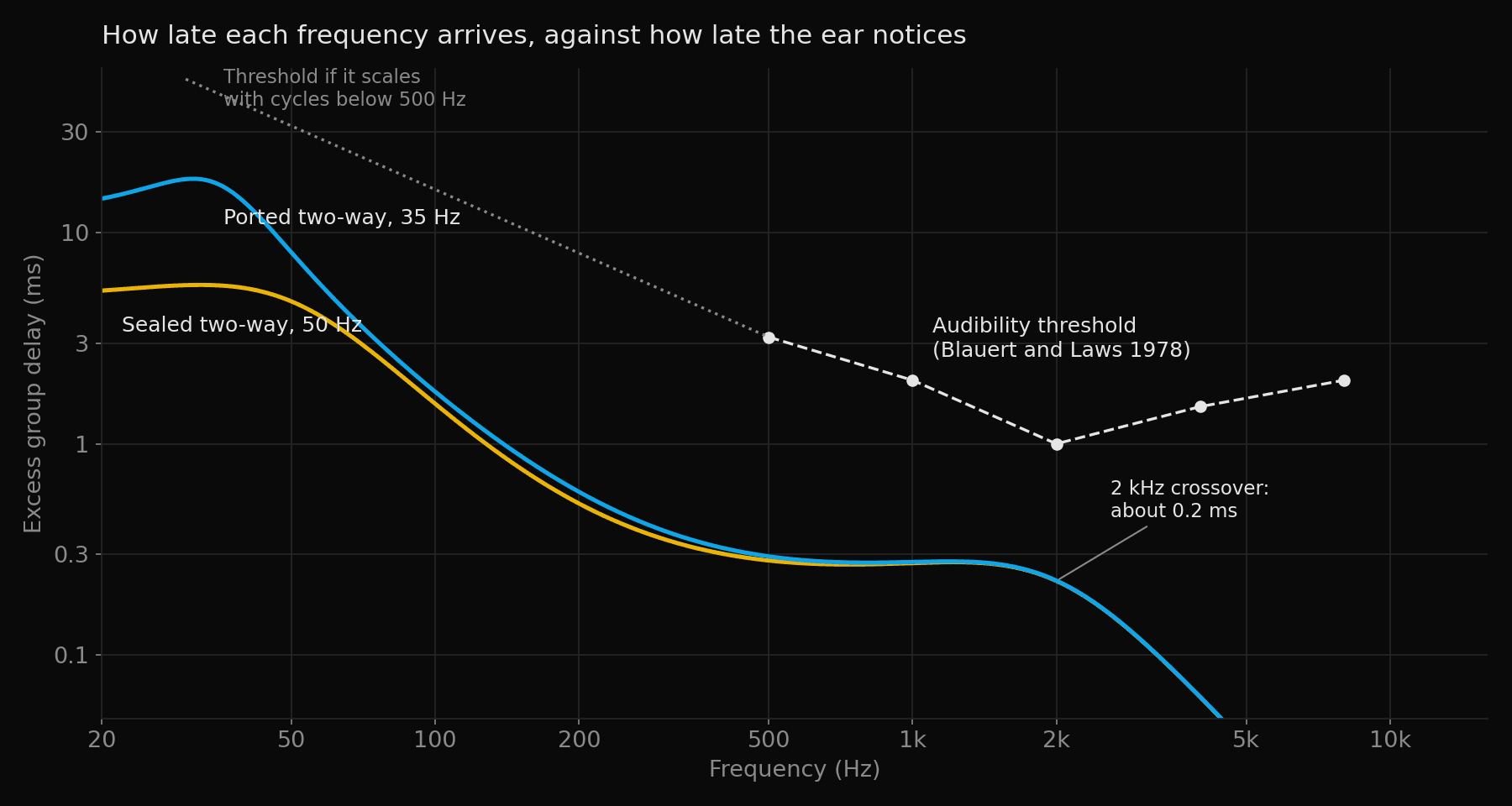
A phase measurement says when each frequency arrives, counted from an arbitrary start. Move your chair or delay the whole signal and every phase value changes, yet nothing sounds different, because every frequency moves by the same time. The audible effects are narrower. Group delay that varies across frequency becomes audible once it passes thresholds that run from about 1 to 3 ms in the midrange. Phase differences between two speakers covering the same band determine whether they add or cancel, and a difference of a few milliseconds is audible. A two-way's 2 kHz crossover adds about 0.2 ms against a threshold of about 1 ms. A sub 4 ms late through an 80 Hz crossover leaves a 6.5 dB dip near 90 Hz.
Phase Is Counted From an Arbitrary Start
Sound travels about 343 metres a second, so every metre between speaker and microphone adds 2.9 ms. At 1 kHz that is more than a thousand degrees of phase. Move your chair back 30 cm and the phase at 1 kHz shifts by another 315 degrees. Nobody hears that as a change in tone, because every frequency moved together.
- Group delay
- How late each frequency arrives, read from the slope of the phase against frequency. If it is the same at every frequency, the system is a pure delay. If it varies, some frequencies arrive after others.
The 2.9 ms per metre is why a raw phase trace from a measurement falls on a slope that wraps around the chart many times. Most of that slope is distance. Measurement software removes it by estimating the arrival time and subtracting it, and what remains is the excess phase: the part that changes the timing between frequencies rather than the timing of everything.
Polarity inversion also changes every frequency at once. Inverting a signal shifts every frequency by 180 degrees. Whether a listener can detect it on music is a separate question from the 180 degree shift, and none of the studies cited in this series tests it. Polarity becomes important only when one inverted source plays alongside another that is not.
Reading a Phase Plot: Relative to What?
Every phase plot measures each frequency against a reference, and the plot's labels do not always name it. Three references are common. The same sub, drawn against each of them, gives three different pictures.
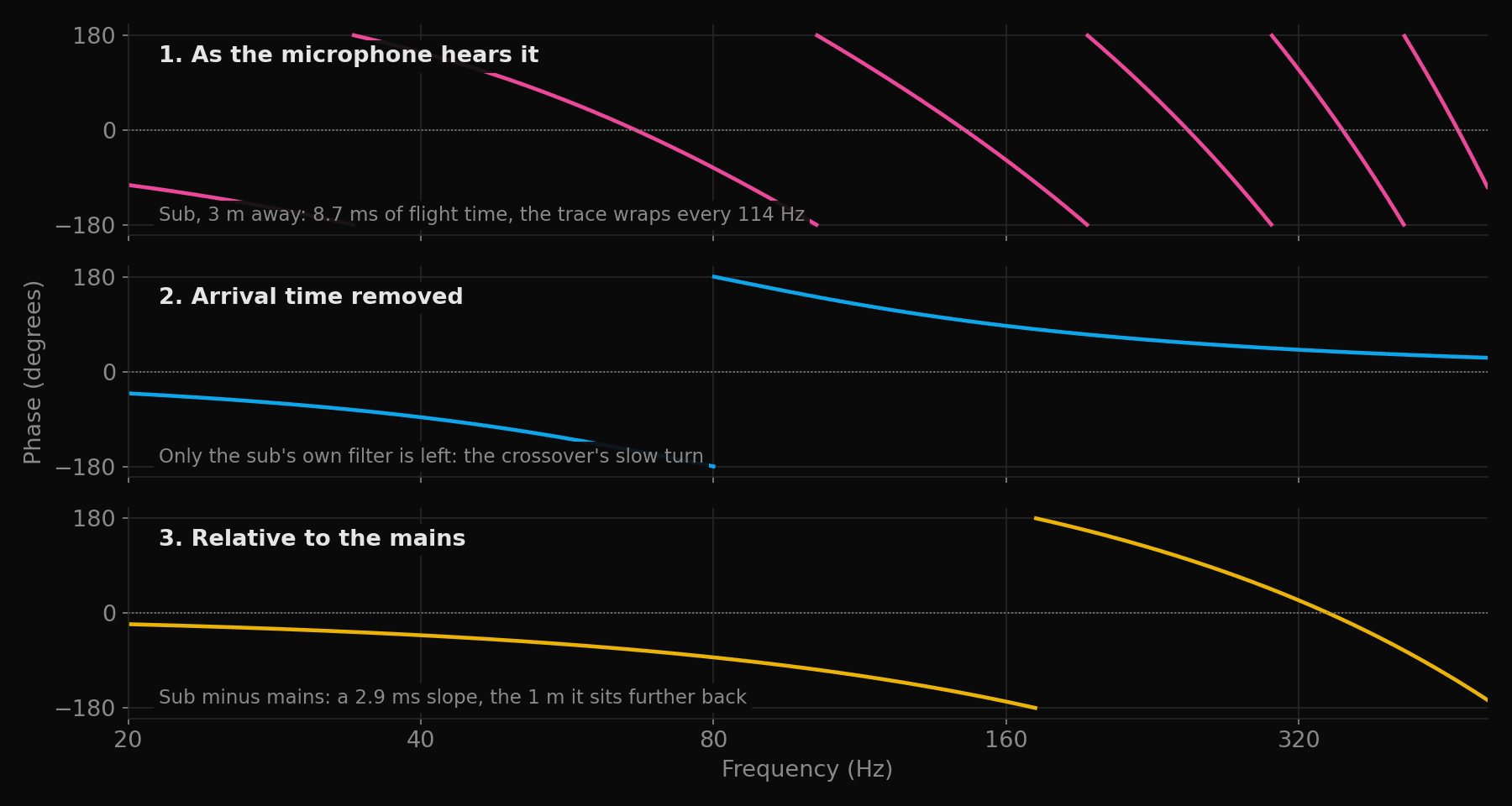
As the microphone records it, the sub's phase includes the 8.7 ms that sound takes to travel 3 m. The trace wraps every 114 Hz, and that pattern describes the distance, not the sub.
With the arrival time removed, only the sub's own filter is left. The arrival-removed view shows what a crossover or a box roll-off does to one speaker, and a group delay plot is drawn from it.
Relative to the mains, the plot shows the difference between two speakers. The sub sits 1 m further back, so its trace falls on a 2.9 ms slope, and the mains, measured against themselves, would sit flat on zero. The relative view predicts whether the two add or cancel, and it is the view the phase drawings on the NEXUS page use.
When a phase plot does not state its reference, look for a trace that sits flat on zero. That trace is usually the reference, and every other trace is drawn against it.
What the Ear Does Pick Up
Two phase effects are audible wherever the phase count starts. The first is group delay that varies across frequency inside one speaker. The second is the phase difference between two speakers that play the same frequencies at the same time.
Group delay inside one speaker
Blauert and Laws measured in 1978 how much group delay variation listeners could detect. The thresholds sit at about 1 ms around 2 kHz, rising to 2 ms at 1 kHz and 8 kHz and 3.2 ms at 500 Hz. Below 500 Hz the data runs out. Holding the threshold at 3.2 ms all the way down is the cautious reading. Later work, including Liski et al. (2018), finds larger thresholds there. Scaling the threshold with the period below 500 Hz is the study's modelling assumption, not a measured value.
| Source | Excess group delay | Threshold there |
|---|---|---|
| Two-way crossover at 2 kHz | About 0.2 ms | About 1 ms |
| Sub crossover at 80 Hz (4th order) | About 5.6 ms | Disputed: 3.2 ms if held flat, 20 ms if it scales with the period |
| Sealed box rolling off at 50 Hz | About 5 ms | 3.2 ms if held flat, 32 ms if it scales with the period |
| Ported box rolling off at 35 Hz | 15 to 20 ms | 3.2 ms if held flat, 46 ms if it scales with the period |
The midrange crossover in a two-way monitor adds about 0.2 ms against a threshold of about 1 ms. Everything larger is in the bass, where the threshold is the open question. The group delay study puts a modelled ported two-way at 4.23 times the threshold if it is held at 3.2 ms below 500 Hz, and 0.36 times if it scales with the period. A sealed two-way is 1.29 and 0.14 times.
Phase between two speakers
When a sub and a pair of mains share the octave around the crossover, both play those frequencies at once and the result at your seat is their sum. If the sub arrives late, the two drift out of phase across that octave and partly cancel. The cancellation is a level loss that shows on any measurement at the seat, and judging it needs no group delay threshold.
A crossover cancellation is a broad dip, about an octave wide. Bücklein (1981) found broad response deviations audible at about 1 to 2 dB and narrow ones from about 3 to 5 dB, with dips harder to hear than peaks of the same size. A 3.2 dB dip an octave wide sits above that broad figure, though 80 Hz lies below the bands Bücklein found most sensitive, 200 to 600 Hz and 2 to 6 kHz.
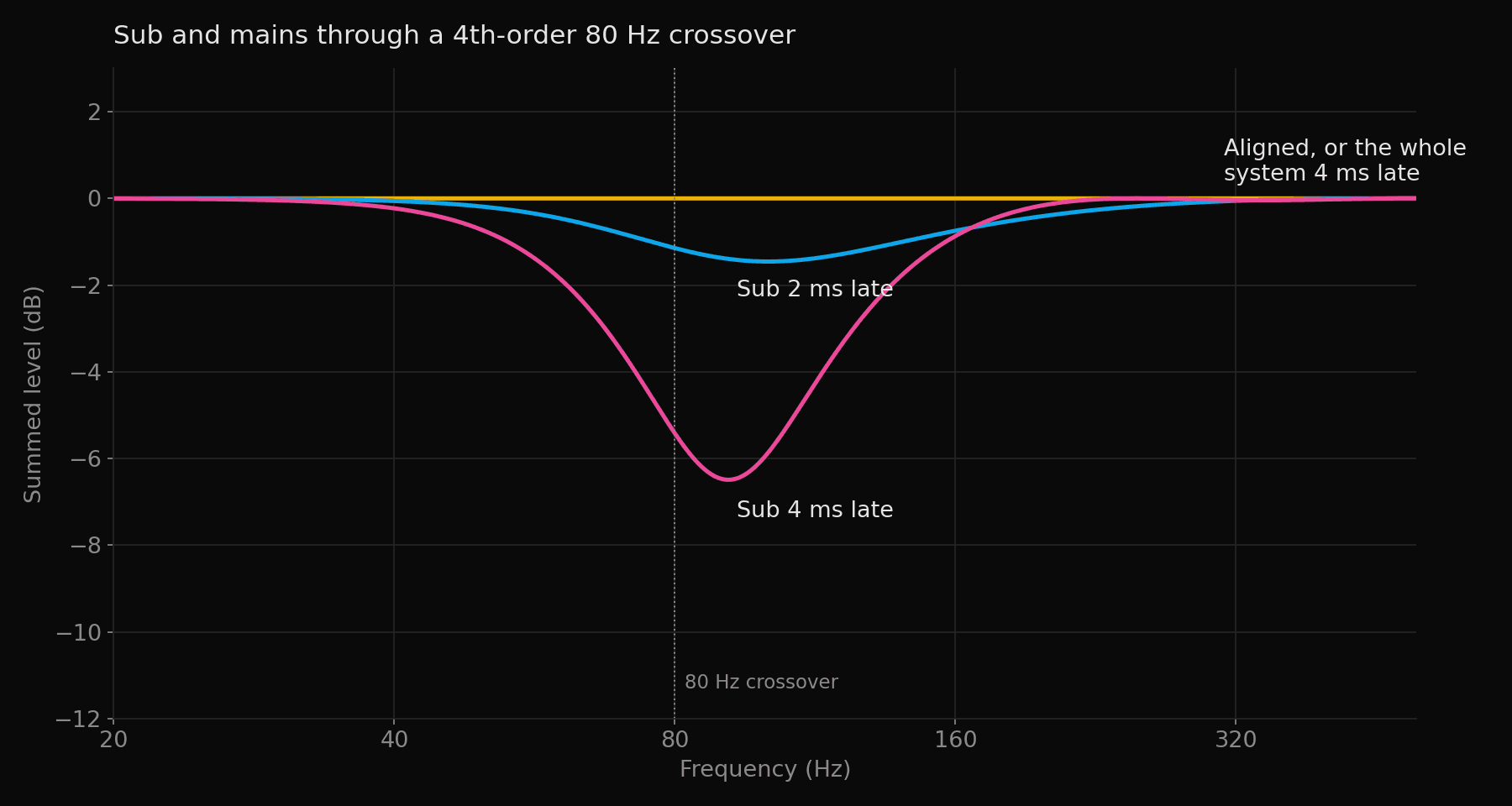
A sub one metre further from you than the mains is about 2.9 ms late before any filter delay is counted, which on this crossover is a dip of 3.2 dB. Ported subs and steep low-pass filters add their own group delay on top. The same 4 ms applied to every speaker at once leaves the summed curve flat.
Phase in a Real Room
Above about 1 to 2 kHz the phase measured at the listening position is dominated by reflections from the desk, the walls and the ceiling. Those paths change length as your head moves, so a 5 cm head movement changes a path's phase by 105 degrees at 2 kHz. A filter that inverts that phase is correct at the microphone and wrong a few centimetres away.
Below about 500 Hz the wavelengths are long compared with head movement. The same 5 cm movement changes a path's phase by 26 degrees at 500 Hz, so the difference between two speakers at the seat holds, and that is the range where aligning speakers to each other holds up.
Where Correction Effort Should Go
Align speakers that share a band before anything else: delay, polarity and the crossover between sub and mains. A sub one metre further back than the mains leaves a 3.2 dB dip at an 80 Hz crossover, and aligning it costs a few milliseconds of delay on the earlier speakers. Correct level problems with minimum-phase filters. In a modelled 50 Hz mode with a +12 dB peak, a matched cut brings the 60 dB decay from about 640 ms to about 50 ms along with the level. Leave single-speaker group delay until last, and weigh what it costs to remove.
Common Misconceptions
A flat phase trace is the goal of correction.
Phase measured at a seat is mostly flight time, and any amount of pure delay is inaudible. The meaningful target is constant group delay once that delay is removed, and only where the variation is large enough to hear.
A phase trace that wraps round the chart many times means something is broken.
Each wrap is 360 degrees, and 3 m of distance produces about 175 of them by 20 kHz. The steep slope is the distance to the microphone. Look at the excess phase after the arrival time is removed.
Time alignment means the impulses line up.
A sub's impulse is a slow swell with no sharp arrival. Two speakers are aligned when their phases agree across the band they share, so they add. Through a narrow crossover there is a ladder of other delays that also add, alternating in polarity, and the nearest two cost about 1 dB and about 3 dB at 80 Hz. Taking the rung nearest zero delay keeps the added latency lowest, at a summation cost of about 1 dB.
Phase correction can fix the whole room at the listening position.
Above 1 to 2 kHz the phase at the seat comes from reflections and changes with every head movement. Correcting it fixes one microphone position and disturbs the rest.
Frequently Asked Questions
Can you hear phase?
Not as an absolute value. A pure delay shifts phase at every frequency and is inaudible. You can hear group delay that varies across frequency once it passes about 1 to 3 ms in the midrange, and you can hear two speakers cancel when they are out of phase in a shared band.
Can you hear polarity inversion?
None of the studies cited here tests it on music. Polarity matters when one source is inverted relative to another playing the same frequencies, such as a sub against its mains, where it determines whether they add or cancel.
What is group delay?
How late each frequency arrives, taken from the slope of the phase response. Constant group delay is latency. Group delay that changes with frequency means some parts of a sound arrive after others.
How much group delay is audible?
Blauert and Laws (1978) found thresholds of about 1 ms near 2 kHz, 2 ms at 1 kHz and 8 kHz, and 3.2 ms at 500 Hz. Below 500 Hz the research disagrees, and later work suggests the threshold rises as frequency falls.
Is the phase shift from a crossover audible?
In the midrange, it sits below the measured threshold. A 2 kHz crossover adds about 0.2 ms of group delay against a threshold of about 1 ms. A sub crossover at 80 Hz adds about 5.6 ms, in the range where the threshold is unsettled.
Why does my sub sound weak at the crossover?
One cause is that the sub arrives late and partly cancels the mains across the shared octave. A sub 4 ms late through a 4th-order 80 Hz crossover leaves a dip of about 6.5 dB. Delaying the mains to meet it, or flipping its polarity where that matches better, removes the cancellation.
Does moving my chair change the phase?
Yes, by hundreds of degrees at higher frequencies, and you will not hear it, because every frequency moves together. Moving between two speakers that share a band is different, because it changes the difference between them.
Conclusion
Most of a measured phase value is the distance from speaker to microphone, and a change of distance alone is inaudible. Spend correction effort on the phase errors that change what reaches your ears: speakers that share a band and arrive at different times, and level problems whose timing comes along with their magnitude. Single-speaker group delay is about 0.2 ms at a 2 kHz crossover against a threshold of about 1 ms, and in the bass its audibility is still argued. Ask any product that claims to fix it which band it works on and what latency it adds.
Glossary
- Absolute phase
- Phase measured from an arbitrary start, dominated by the distance from speaker to microphone.
- Excess phase
- The phase left once the arrival time is removed, which is what changes the timing between frequencies.
- Group delay
- How late each frequency arrives, from the slope of the phase response.
- Polarity
- The sign of the signal. Inverting it shifts every frequency by 180 degrees.
Sign up to hear more when we release something new


