



Is Room Correction Software Worth It?
Room correction is worth it in some rooms and close to pointless in others, and the difference is predictable enough to work out before you spend anything. It reliably improves broad tonal balance, the response through a subwoofer crossover, and the level and timing match between speakers. It cannot shorten a decay time, fill a cancellation null, or make an untreated room behave like a treated one. This guide sets out which problems belong to correction, which belong to treatment, and how to tell which of them your room mostly has.
What Correction Reliably Fixes
Three classes of problem respond well, and it is worth being specific because the marketing for this category is not.
The first is broad tonal error. A room with a shelf of extra energy in the low mids, or a dull top end from soft furnishings, has a magnitude error that behaves as a minimum-phase system, and a filter of the opposite shape genuinely cancels it. This is the least glamorous benefit and the most reliable one.
The second is level and timing between speakers. Two monitors at slightly different distances, or a subwoofer a metre from the mains, arrive at different times and partly cancel through the region where they overlap. Measuring that and applying delay is straightforward, and the improvement is usually obvious.
The third is the subwoofer crossover region, which combines both of the above and is where most systems are worst before correction and best after it.
What It Cannot Touch
The limits are physical rather than a matter of product quality.
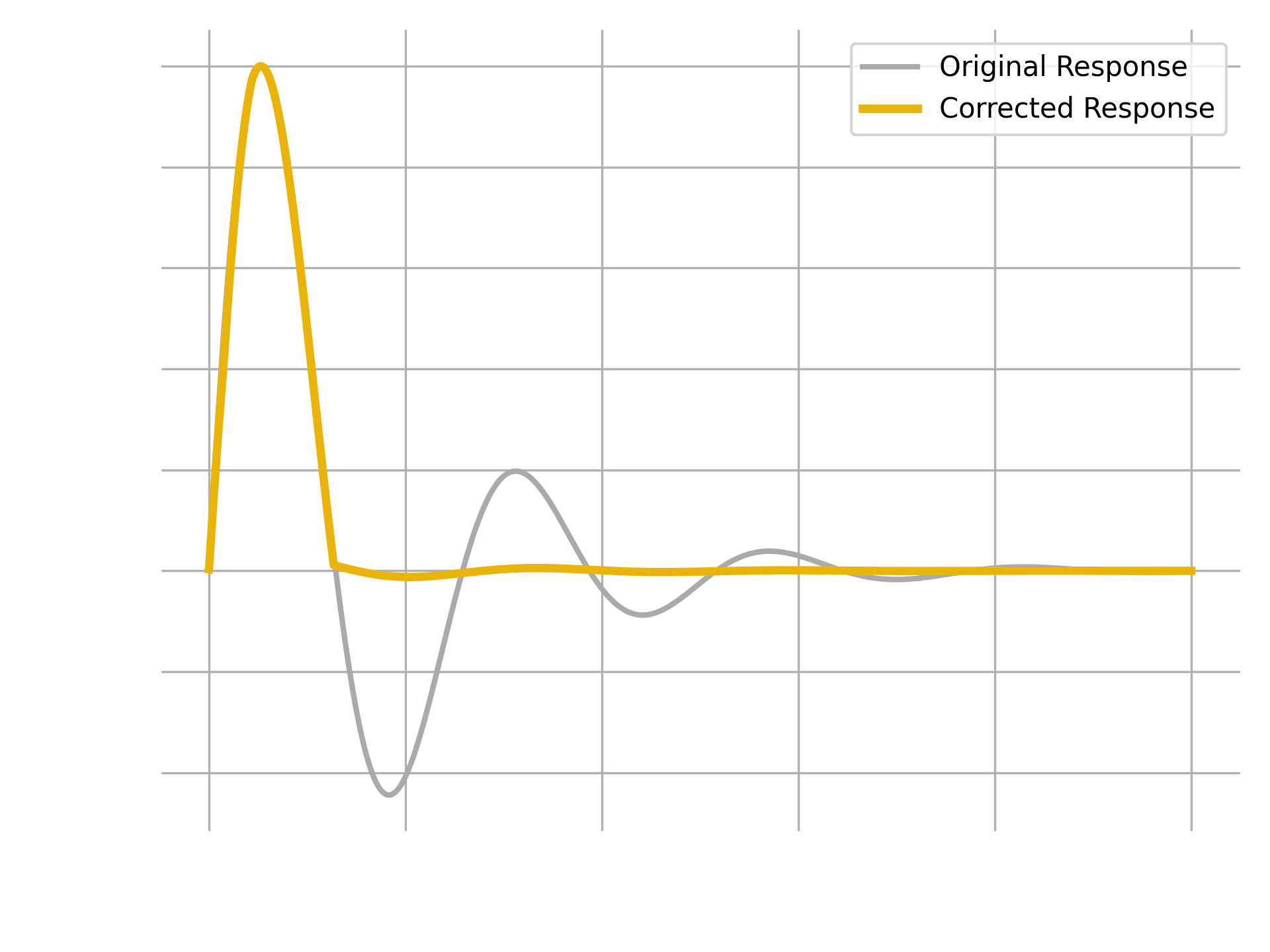
A mode ringing for 600 milliseconds at 45 Hz is a resonance of the air in the room. A filter can reduce the energy going into it, which lowers the level of the ring, and it cannot make the ring shorter. The note still hangs on after it should have stopped. Only absorption changes a decay time.
A null caused by a reflection arriving out of phase with the direct sound is a cancellation at that point in space. Boosting into it spends amplifier headroom and driver excursion on energy that cancels again on arrival. A good correction product refuses to try; a poor one boosts and tells you it fixed something.
Anything that changes substantially when you move your head is position-dependent, and a correction computed for one position cannot be right at another. Multi-position measurement mitigates this by aiming at an average, which is a compromise rather than a fix.
Working Out Which Case You Are In
You can answer this in an evening with a measurement microphone and free software.
- 1Measure the response at your listening position.
- 2Measure again 30 cm to one side, and again 30 cm up.
- 3Compare the three. If they broadly agree, your errors are mostly minimum-phase and correction will help materially.
- 4If they disagree wildly below 200 Hz, you are looking at modal behaviour and cancellation. Bass trapping comes first, and correction afterwards will do more.
- 5Look at the decay. Long ringing at specific low frequencies is a trapping problem however flat the magnitude response looks.
The measurement costs the price of a microphone and an evening. It is the cheapest part of this decision and the only part that answers it.
Common Misconceptions
Room correction means I do not need acoustic treatment.
Correction adjusts the signal sent to the speaker. Treatment changes how the room behaves. A filter cannot shorten a decay or fill a cancellation, so the two fix different halves of the problem.
If the measured response is flat after correction, the room is fixed.
A flat magnitude response says nothing about decay time. A room can measure flat at the listening position and still ring for half a second at 50 Hz, which is audible as bass that arrives late and overstays.
Correction will make cheap monitors sound like expensive ones.
It corrects the room's contribution and some of the speaker's minimum-phase response. It does not change distortion, dispersion, dynamic behaviour or how the speaker holds up off axis.
Frequently Asked Questions
Is room correction software worth it for a small home studio?
Usually yes, provided you have done some bass trapping and you keep your expectations about the low end realistic. The tonal balance and the timing improvements are real. The modal problems remain a room matter.
Will room correction fix my room modes?
It can reduce the level of a modal peak by putting less energy into it. It cannot shorten the decay, so the note still rings on. Nulls caused by cancellation cannot be corrected electrically at all.
Is free room correction good enough?
Free measurement software plus a parametric EQ will get you most of the tonal correction, and it is a good way to find out whether correction helps in your room before buying anything. What paid products add is automation, multi-position handling and alignment.
Does room correction add latency?
It depends on the filter type. Minimum-phase IIR correction adds a negligible amount. Linear-phase FIR correction adds latency proportional to the filter length, which can be several milliseconds or more and matters if you record while monitoring.
Should I treat the room first or correct it first?
Treat first where you can. Correction applied to a treated room produces a better and more position-stable result, and treatment applied after correction invalidates the correction, so you will measure again anyway.
Conclusion
Room correction is worth it when your room's errors are mostly broad and minimum-phase, and when speaker timing and a subwoofer crossover are in play. It is worth much less when the dominant problems are long decays and deep position-dependent nulls, which is the untreated small-room case. Measure at three positions before deciding; that single evening tells you which of those rooms you have, and it costs less than any of the software.
Sign up to hear more when we release something new


