



Do You Need a Calibrated Measurement Mic?
Whether you need a calibrated measurement microphone depends on what you intend to do with the measurement. If you are looking for gross problems, where the modes are and whether one speaker is louder than the other, an uncalibrated microphone will show you all of it. If you are computing a correction and applying it, the microphone's own error goes into the correction and gets baked into everything you hear afterwards. This guide sets out where in the spectrum calibration actually changes the answer, and how to decide.
What Calibration Actually Changes
It is worth being specific about where the error lives, because the answer is not uniform across the spectrum.
Below roughly 300 Hz, which is where nearly all room correction work happens, a decent electret capsule is close to flat and the unit-to-unit variation is small. The errors you are looking at in that region are tens of decibels of modal peak and null. A microphone error of a decibel is not what is misleading you.
Above about 5 kHz the picture changes. The capsule's own response rises or falls, the microphone body starts to diffract sound around itself, and the differences between individual units grow. This is the region where an uncalibrated measurement will tell you the top end is bright or dull when it is the microphone.
The bottom octave has its own version of the same problem. Capsule and preamp roll-off below 30 Hz varies, and if you are setting a subwoofer's low-end alignment from an uncalibrated measurement, you are partly aligning to a microphone.
When You Need It and When You Do Not
| What you are doing | Calibration needed |
|---|---|
| Finding room modes and nulls | No. The errors dwarf the microphone. |
| Checking speaker placement by ear plus a sweep | No. You are comparing before and after with the same microphone. |
| Matching left and right level and timing | No. Relative measurements cancel the microphone's error. |
| Setting a subwoofer crossover and delay | Helpful. The alignment sits in a region where roll-off differences start to matter. |
| Computing and applying a full-range correction | Yes. The microphone's error becomes part of the correction. |
| Comparing your room against published measurements | Yes. Without it you are comparing two different instruments. |
The pattern is that relative measurements tolerate an uncalibrated microphone and absolute ones do not. If you are comparing the same room to itself before and after a change, the microphone's error is present in both and largely cancels. If you are computing a target-relative correction, it does not.
The Practical Answer
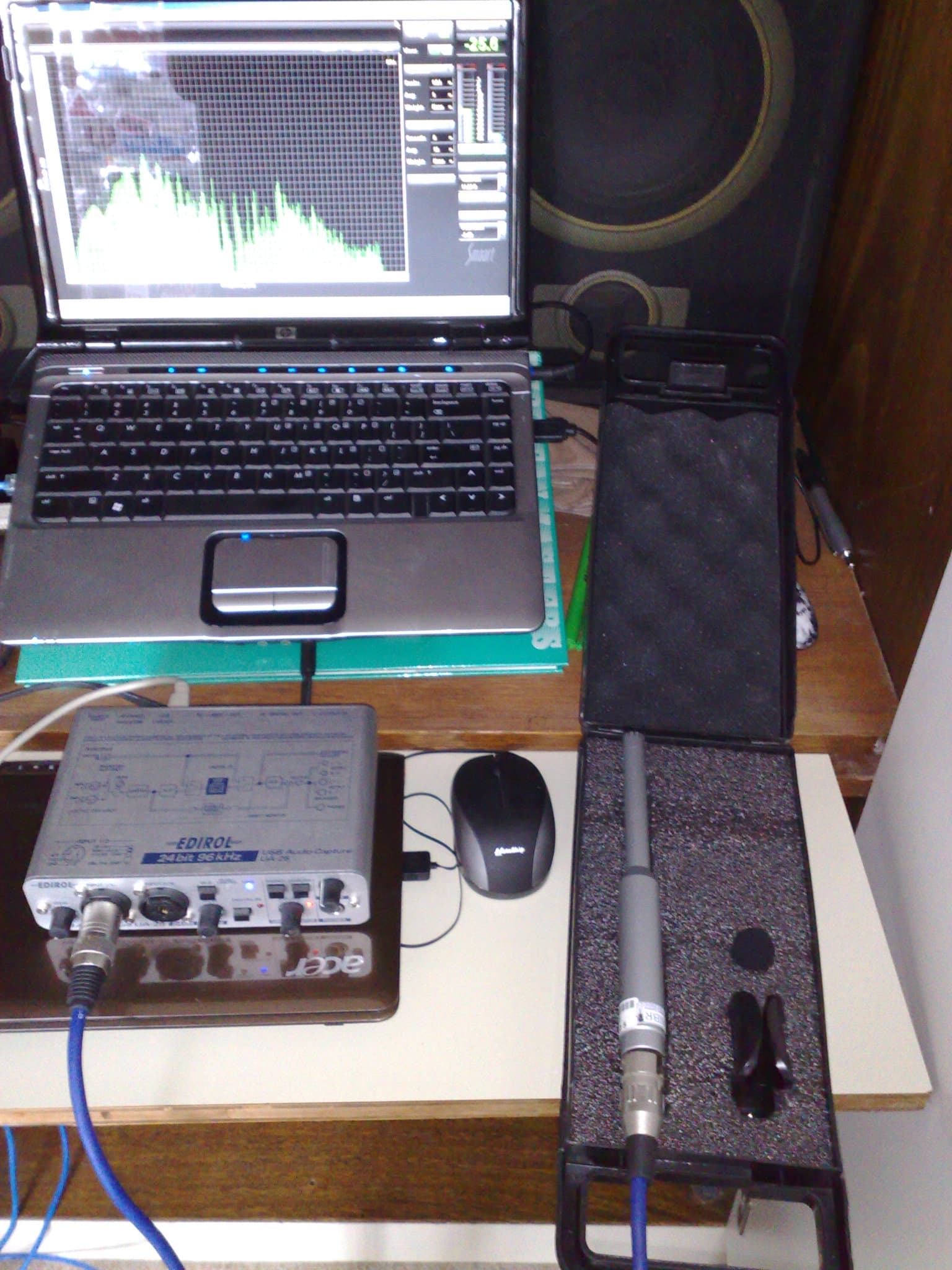
If you already own an uncalibrated microphone, use it. Measure the room, find the modes, fix the placement, add trapping and measure again. All of that work is comparative and none of it needs a file.
Before you apply a computed correction and leave it in the path, get a microphone with an individual calibration file. The cost is small, it is a one-off, and the alternative is a correction with an unknown microphone error folded into it, sitting on everything you hear until you next measure.
If you buy one microphone and want it to cover both cases, buy the calibrated one first and skip the intermediate step.
Rules of Thumb
Frequently Asked Questions
Can I do room correction without a calibrated microphone?
You can measure without one and learn a great deal. Computing a correction from an uncalibrated measurement bakes the microphone's error into everything you hear afterwards, which is the one part worth paying to avoid.
How much difference does calibration make in the bass?
Very little. Capsule variation below 300 Hz is small and room errors there are tens of decibels. Calibration matters at the extremes of the range, not in the region most correction work targets.
Is a generic calibration file good enough?
It removes the part of the error common to the model, which is most of it. An individual file removes the part specific to your unit. For applied correction, individual is worth the small extra cost.
Does the microphone need recalibrating?
Not on a schedule for normal indoor use. Heat, humidity and physical shock are what move a capsule. If the microphone has had a hard life, recalibrate rather than assume.
Will a calibrated microphone make my correction better?
It makes it more correct, which is not the same as more dramatic. The audible difference is usually at the top of the range, where an uncalibrated measurement often produces a correction that sounds subtly dull or bright.
Conclusion
Use whatever microphone you have to find problems, and get an individually calibrated one before you compute a correction you intend to leave in place. The distinction that decides it is comparative against absolute: comparing a room to itself tolerates an unknown instrument, and computing a target-relative correction does not. The limit worth stating: calibration removes the microphone from the measurement and does nothing about the fact that one microphone position describes one point in the room.
Sign up to hear more when we release something new


