



Best Measurement Microphones for Room Correction

A measurement microphone exists to tell you what is actually happening at the listening position, which makes its own errors the one thing you cannot measure your way out of. The specification that matters most is not the capsule or the body, it is whether the microphone comes with a calibration file measured from that individual unit rather than a generic curve for the model. Everything else, omnidirectional pattern, phantom power, a flat response through the range you care about, is common to the whole category. This guide covers what to buy and why the calibration file is the answer.
Why the Calibration File Is the Product
Electret capsules vary from unit to unit within a production run. That variation is small in absolute terms and large compared with the room errors you are trying to identify, particularly at the top and bottom of the range where the capsule and the body start to matter.
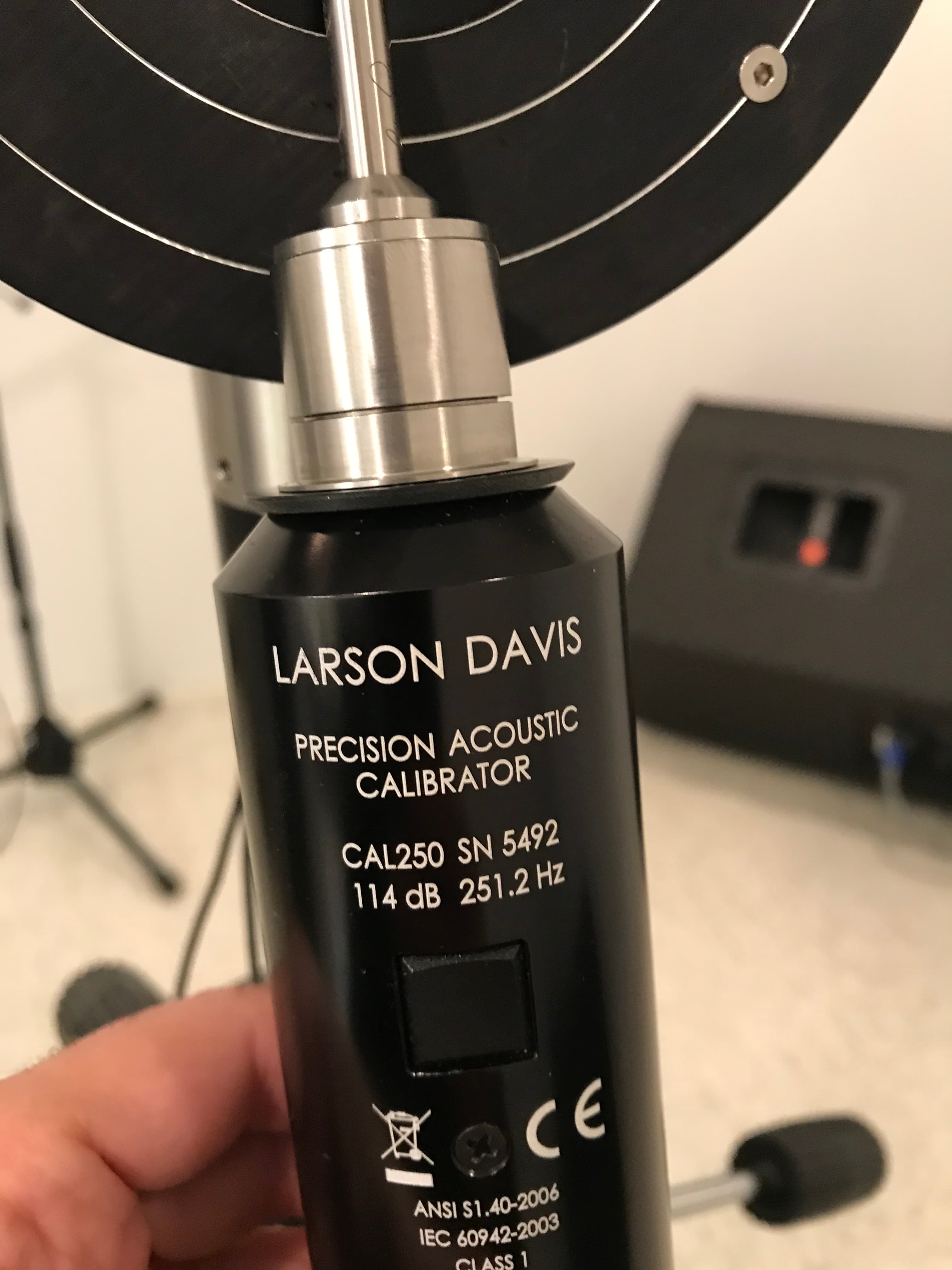
A calibration file is a list of frequencies and corrections that your software applies to the raw measurement, so what you see is the sound field rather than the microphone. There are two grades of it. A generic file describes the average of the model, and corrects the part of the error common to all of them. An individual file is measured from your microphone against a laboratory reference and corrects the part that is specific to it.
If you are correcting a room on the strength of a measurement, the individual file is the difference between correcting the room and correcting the microphone.
What to Look For
- An omnidirectional pattern. Directional microphones have proximity effect and a polar pattern that varies with frequency, which makes a room measurement unrepeatable.
- An individual calibration file tied to the serial number, supplied as plain text your software can read.
- Standard phantom power at 48 V and a balanced XLR output, so any interface will drive it.
- A slim body. A large-diameter body diffracts sound around itself and colours the measurement above a few kilohertz.
- A stated calibration reference. Knowing what the file was measured against tells you how much to trust it.
What not to buy on: a quoted frequency range with no tolerance attached, a low self-noise figure that matters for recording and not for measurement, or a USB connection that ties the microphone to one measurement application.
USB or XLR
USB measurement microphones are convenient and lock you into whatever sample rate and driver the manufacturer provides, and they cannot be used as one channel of a two-channel transfer function measurement. If you expect to do anything beyond a single-channel sweep, buy the XLR version.
What People Actually Buy
The established options are close enough in performance that the choice comes down to calibration grade and price.
| Microphone | Calibration | Notes |
|---|---|---|
| Behringer ECM8000 | None supplied | The cheap standard for years. Usable with a generic curve; capsule variation is the known weakness. |
| Dayton Audio EMM-6 | Individual file supplied | Long-standing budget choice with individual calibration, which is the important part. |
| miniDSP UMIK-1 and UMIK-2 | Individual file, USB | Convenient and single-channel only. Good for sweeps, unsuitable for two-channel transfer function work. |
| Earthworks M23 and similar | Individual, laboratory grade | Substantially better above 10 kHz and below 20 Hz. More microphone than room correction needs. |
| Tantrum TMM9000 | Individual file, matched to serial | Omnidirectional condenser on XLR and 48 V, calibrated one at a time against a lab reference. Ships as the standard mic with NEXUS. |
Whichever you choose, keep the calibration file with the microphone. A measurement microphone with a lost calibration file has been demoted to a generic one.
Common Misconceptions
A measurement microphone needs to be expensive to be accurate.
Below a few hundred pounds the differences are mostly at the extreme top and bottom of the range. For room correction work, an individually calibrated budget microphone is close to indistinguishable from a laboratory one.
Any microphone with a flat response will do.
Flat on a data sheet describes the model on axis in free field. A room measurement needs an omnidirectional pattern that stays consistent off axis, which is a different property and the reason studio condensers are unsuitable.
The calibration file is a nice extra.
It is the product. Without it you are measuring the sum of the room and an unknown microphone error, and correcting both.
Frequently Asked Questions
Do I need a calibrated measurement microphone for room correction?
Yes, if you intend to act on the measurement. Uncalibrated capsule variation is comparable in size to the response errors you are trying to correct, so an uncalibrated measurement can send you in the wrong direction at the top and bottom of the range.
Can I use a normal studio condenser to measure my room?
Not reliably. Studio condensers are directional, have proximity effect, and are voiced rather than flat. You can see gross problems with one, and you should not compute a correction from it.
USB or XLR measurement microphone?
XLR unless you are certain you will only ever run single-channel sweeps. A USB microphone cannot be one input of a two-channel transfer function measurement, which rules out live measurement techniques.
What is the difference between individual and generic calibration?
A generic file corrects the average error of the model. An individual file is measured from your microphone against a reference and also corrects the part specific to your unit. For correction work, individual is the one worth paying for.
How long does a calibration last?
Electret capsules drift slowly and most stay within tolerance for years of normal indoor use. Heat, humidity and being dropped are what age them. If a microphone has had a hard life, a recalibration is cheaper than a wrong correction.
Conclusion
Buy an omnidirectional measurement microphone on XLR with an individual calibration file tied to its serial number, and do not spend beyond that unless you are doing work the room correction case does not require. The file is the product. The limit worth naming: a perfect microphone still measures one point in a room, so the number of positions you measure matters more to the final correction than the last decibel of microphone accuracy.
Sign up to hear more when we release something new


