


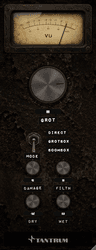
DAMAGE is mechanical destruction of the driver. It is not a drive control with a distortion curve: it's a sequence of physical failures that arrive in order as you turn it up, and each one behaves differently depending on what you play into it.
What's happening underneath
The signal is split into three bands (below 250 Hz, 250 Hz to 2 kHz, and above 2 kHz) and each is driven through its own asymmetric speaker-like shaper. The split is subtractive, so with DAMAGE at zero the bands sum back to exactly the original signal and there are no crossover artefacts to hear.
On top of that, DAMAGE controls five separate things that arrive at different points on the knob.
The stages, in the order they arrive
From zero: instability and tearing
Two things start immediately.
A slow random wobble, around 3 Hz, modulates how hard each band is being driven, so the speaker never sounds settled. It's scaled hard at the bottom of the knob, near-silent at low settings, and only really stirs once you push in.
And the torn cone starts to work. This is a modelled flap of slashed paper whose cut edges swing freely one way and jam against each other the other way, driven by the cone's own excursion. Crucially it doesn't add a sound: it modulates your signal, so the buzz is your own note rectified and choked. Quiet passages stay clean, loud ones tear up, and silence stays silent.
From about 40: the driver slap
Past 40 a mechanical flam appears on hard transients: the loose driver physically slapping about 10 ms behind the hit, rung through deep cone resonances.
It only fires on genuine transient onsets, and there's a 60 ms lockout after each one so it never degenerates into a flutter. It stays a physical event rather than an effect.
The slap follows MODE: high and tight in GROTBOX (315 Hz / 630 Hz, and boosted so it cuts through that box's mids), deep and slow in BOOMBOX (63 Hz / 126 Hz).
From about 60: terminal failure
The last part of the knob is the driver dying. The voice coil starts slamming into a shrinking excursion limit and knocking on the back plate, and the cone begins flapping an octave down, the flabby, motorboat blat of a blown woofer, with the radiation cutting out intermittently as it goes.
Like the tearing, all of it is derived from your signal. Nothing free-runs. Push nothing through it and it makes no noise at all.
Throughout: losing the top and finding its own resonances
Across the whole range the high end progressively collapses, and the broken cone develops two resonances of its own, a low-mid honk around 340 Hz and an upper-mid rattle around 1.6 kHz, that get both louder and narrower as the damage worsens. These live in the cone, not the box, so DIRECT mode gets them too.
How the knob is shaped
The travel is deliberately not linear in effect:
| Position | What dominates |
|---|---|
| 0–35 | Crunch: multiband breakup, slow instability, a first hint of tearing |
| 35–60 | The driver slap arrives; the high end starts to rasp and collapse |
| 60–100 | Terminal failure: bottoming, subharmonic blat, cut-out |
The shaper drive itself plateaus around the middle of the knob. Past that point more crunch would just be harsher fizz, so the escalation is handed over to the tearing and terminal stages instead. The result is that the top of the knob reads as mechanical failure rather than more distortion.
What changes DAMAGE without you touching it
Two things push the effective damage beyond where you set the knob.
- MODE. BOOMBOX scales the breakup up by 40%. The same setting is meaningfully more broken there than in GROTBOX or DIRECT.
- The GROT knob. A speaker under strain also breaks down faster, so turning GROT up advances DAMAGE too, by up to about 18% of the knob's travel at full GROT. This affects the character stages as well as the drive, so pushing GROT can bring the slap and the terminal failure in earlier than the DAMAGE readout suggests.
If you want the slap without the crunch, keep DAMAGE just above 40 and use GROTBOX. If you want the crunch without the slap, stay below 40 and reach for the GROT knob instead.
DAMAGE adds no noise. Everything it does is a consequence of the signal you feed it, so it goes quiet when your track does. Noise that persists in the gaps comes from FILTH.


