


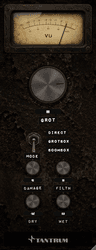
This guide covers GROT 0.1.2, the speaker-degradation plugin from Tantrum Audio, for macOS in AU and VST3 formats. An AAX build for Pro Tools is coming soon, and this guide will cover it when it arrives.
Who it's for
You mix, produce or sound-design, and you want to know exactly what each control is doing so you can reach for the right one instead of turning knobs until something happens. No DSP background is assumed. Where a number helps (a crossover point, a resonance, a threshold) it's given, because on a distortion box those numbers change what you reach for next.
How it's organised
- Getting started: what GROT is, how to install it, and the shortest route to a usable sound.
- The controls: one chapter per control on the front panel, in the order they appear: MODE, DAMAGE, GROT, FILTH, DRY and WET.
- Advanced: the hidden panel behind the meter (input staging and sidechaining), and a set of worked settings for real material.
- Help & reference: troubleshooting, a glossary, the full parameter table, specifications and support.
If you only read one chapter, read the quick start. If you only read two, read the quick start and MODE.
Conventions
- DAMAGE, GROT, WET and so on are controls on the panel, spelled exactly as the panel spells them.
- Knob positions are given as percentages, matching the number the panel shows. "DAMAGE at 45" means the readout under the DAMAGE knob reads 45.
- DRY and WET are level controls and read in decibels, where -inf means fully muted and 0.0 means unity.
The word GROT means two things and the manual keeps them apart. GROT is the plugin. The GROT knob is the control in the middle of the panel that drives the speaker into strain.
Safety
GROT is a distortion. It generates harmonics and noise that were not in your source, and at high settings it can be substantially louder than the signal you fed it.
Turn your monitors down before you first insert GROT and before any large move of DAMAGE or the GROT knob. Both change output level as well as tone. Never audition extreme settings on headphones at working volume.
The processing is entirely internal. GROT does not write to disk, does not phone home, and cannot damage your speakers other than by the ordinary route of being played too loud.


