


Terms as this manual uses them.
Terms
| Term | Meaning |
|---|---|
| AAX | Avid's plug-in format, used by Pro Tools. |
| AU (Audio Units) | Apple's plug-in format, used by Logic Pro and GarageBand. |
| Bark | The resonance the GROT knob sweeps down from 1.1 kHz toward 420 Hz as it's turned up. It's what makes strain read as effort rather than as fuzz. |
| Bit depth reduction | Throwing away resolution in the signal, adding a grainy quantisation texture. In GROT it's part of FILTH, applied gently and continuously rather than as an obvious bitcrusher. |
| Bottoming | A voice coil hitting the end of its travel. Part of DAMAGE's terminal-failure stage above 60. |
| Chainsaw | The dense, bright, presence-boosted saturation layer that ramps in above 50 on the GROT knob, in the manner of an HM-2 pedal. |
| Cone breakup | A driver's cone flexing instead of moving as one piece, producing resonances and distortion that aren't in the signal. The subject of the DAMAGE control. |
| Crackle | Sparse random impulses with a fast decay, modelling corroded contacts. One of FILTH's three layers. |
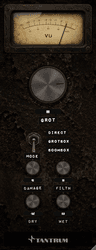
| Damage done | What GROT's VU meter reads: the size of the difference between output and input, relative to the input. 100% means the change is as big as the signal. |
| Driver slap | The mechanical flam a loose driver makes about 10 ms behind a hard transient. Engages above 40 on DAMAGE. |
| Dual-mono | Left and right processed by completely independent chains, with no shared detector or crosstalk. |
| Excursion | How far a cone physically moves. Most of GROT's mechanical stages are driven by a modelled excursion rather than by the waveform, which is why they respond to level and to low frequencies. |
| Grime | FILTH's continuous low-mid noise floor, band-limited to 150 Hz – 3.5 kHz and keyed to signal presence. |
| Level match | GROT's internal automatic trim, which slowly nudges the wet path's energy back toward the input's so that changing DAMAGE and GROT changes tone rather than volume. |
| Program-locked | An effect whose output is derived entirely from the input, so it goes quiet when the source does. Everything in DAMAGE and the GROT knob is program-locked, while FILTH deliberately isn't. |
| Sidechain | A second audio input used to control the effect rather than be processed by it. GROT's sidechain rides the DAMAGE, GROT and FILTH knobs between zero and their set positions. |
| Subharmonic blat | The flabby octave-down flapping of a blown woofer, part of DAMAGE's terminal-failure stage. |
| Subtractive crossover | A band split where the bands are derived by subtraction, so they sum back to exactly the original signal. It's why DAMAGE at zero is transparent. |
| Terminal failure | DAMAGE's final stage, from about 60 upwards: bottoming, back-plate knock, subharmonic blat and intermittent cut-out. |
| Tilt | A pair of complementary shelves either side of a pivot frequency, so turning one up turns the other down. GROT's TILT pivots at 800 Hz and sits ahead of all distortion. |
| VST3 | Steinberg's plug-in format, used by most hosts other than Logic and Pro Tools. |
| Zipper noise | The stepping you hear when a parameter changes in jumps instead of smoothly. GROT avoids it with per-parameter smoothing and by recalculating filters every 32 samples rather than once per audio block. |


