


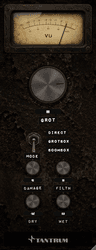
MODE picks the box you're playing through. It's the most consequential control on the panel, because it doesn't only change the tone: it changes how every other control behaves.
The three positions
Three positions, selected with the lever: DIRECT at the top, GROTBOX in the middle, BOOMBOX at the bottom. GROTBOX is the default.
DIRECT
No cabinet at all. The signal keeps its full bandwidth and no enclosure resonances are imposed.
Everything else still works: DAMAGE still tears the cone, the GROT knob still produces strain, FILTH still adds its noise floor. What you lose is the band-limiting and the box's own resonant character, and the gentle top-end sheen that GROT restores to the two speaker voicings, which DIRECT doesn't need.
Use DIRECT when the source already has a cabinet sound of its own, when you're degrading a full mix and can't afford to lose the extremes, or when you want the mechanics without the small-speaker tone.
GROTBOX
A tiny, cheap, mid-forward box, the sort bolted to a PA column or rattling around in a practice combo.
| Property | GROTBOX |
|---|---|
| Bandwidth | roughly 320 Hz – 3.2 kHz |
| Resonances | 245 Hz, 1.1 kHz, 2.6 kHz |
| Driver slap | high and tight (315 Hz / 630 Hz), and boosted so it cuts through |
| Character | honky, forward, aggressive |
The three resonances aren't fixed. As DAMAGE rises they get both louder and narrower, because a cone losing control doesn't just ring, it rings for longer. That's most of what makes GROTBOX the nastiest of the three modes.
GROTBOX also reacts hardest to the GROT knob. It's modelled as the smallest enclosure, and small enclosures get angry soonest, so the same GROT setting bites more here than anywhere else.
Use it on drums, on anything that needs to sound like it's coming out of a phone or a laptop, and whenever you want the transient slap to be obvious.
BOOMBOX
A big ported enclosure with far too much low end and a dull top.
| Property | BOOMBOX |
|---|---|
| Bandwidth | roughly 45 Hz – 4.5 kHz |
| Port resonance | 65 Hz, high Q, already +7.5 dB and swelling further with DAMAGE |
| Mid presence | 720 Hz, so the sound doesn't disappear |
| Driver slap | deep and slow (63 Hz / 126 Hz) |
| Character | heavy, boomy, dark |
The port is the whole point. It sits right where kick drums and bass live, it rings hard, and as DAMAGE increases it rings harder and longer until the woofer feels like it's on the edge of excursion.
BOOMBOX also drives the cone breakup harder than the other modes: DAMAGE is scaled up by 40% here, on the reasoning that a big cone gets flogged more for the same input. Expect the same DAMAGE setting to sound noticeably more broken in BOOMBOX than in GROTBOX.
Use it on bass, on kicks that need to feel oversized, and on anything you want to sound like it's being played through the back of a van.
Choosing between them
| If you want | Use |
|---|---|
| Degradation without a speaker sound | DIRECT |
| Small, cheap, honky, aggressive | GROTBOX |
| Big, boomy, dark, oversized | BOOMBOX |
| The most obvious transient slap | GROTBOX |
| The most low-end weight | BOOMBOX |
| The most extreme response to the GROT knob | GROTBOX |
| The most extreme response to DAMAGE | BOOMBOX |
MODE is a discrete switch with no crossfade. Changing it mid-audio is instantaneous and can click, because the cabinet filters change state in one sample. Automate it during a gap or on a transient.
If DAMAGE sounds too clean, change MODE before you turn DAMAGE up. The same amount of breakup is far more audible through GROTBOX's narrow, resonant band than through DIRECT's full bandwidth.


