


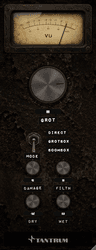
GROT is a plugin that plays your audio through a broken speaker. Not a modelled cabinet, not an impulse response of a good speaker in a good room. A cheap box whose cone is torn, whose surround is loose, whose contacts are corroded and whose voice coil is about to bottom out.
The idea
Most distortion plugins are circuits: a tube, a transistor, a clipper. GROT is a mechanical system. Everything it does is something physically going wrong at the point where electricity becomes air:
- the cone loses control and develops its own resonances;
- a loose driver slaps a few milliseconds after a hard transient;
- a slashed cone buzzes against its own cut edges, and jams;
- a voice coil hits its excursion limit and knocks on the back plate;
- grime and corrosion add hiss and crackle whether you asked for it or not.
That distinction matters in use. A circuit distortion sounds the same whatever you play through it. A mechanical one is program-locked: it responds to how hard and how low you hit it, it stays quiet when you stay quiet, and it falls apart in a way that follows the performance instead of sitting over the top of it.
What's on the panel
Four controls do the work, and two set the blend.
| Control | What it breaks |
|---|---|
| MODE | Which speaker you're playing through: none, a small mid-forward box, or a big ported one |
| DAMAGE | Mechanical cone breakup: instability, resonance, driver slap, tearing, terminal failure |
| GROT | Low-mid strain: what a speaker does when it's driven far harder than it was built for |
| FILTH | Neglect: noise floor, crackle and digital corruption that are there whatever you play |
| DRY / WET | Two independent output levels, so parallel use is a first-class option |
Behind the VU meter there's a hidden panel with input gain, a spectral tilt, and a sidechain that lets another track drive the destruction. Chapter 10 covers it.
What it is not
- Not a cabinet simulator. GROT will not make a DI'd guitar sound like a well-recorded amp. It will make it sound like it's coming out of something that should have been thrown away.
- Not an impulse response loader. There are no IRs and nothing to load.
- Not subtle by default, though it can be. With DRY and WET as separate levels, GROT is as usable as a parallel colour stage as it is as a wreck-everything insert.
What you'll use it on
Drum busses that are too clean and too polite. Synths that need to sound like they came out of something with a handle on it. Vocals that need to fall apart on one line. Bass that needs to be audible on a phone. Whole mixes, in parallel, when the arrangement is fine and the sound is boring.
Chapter 11 has worked starting points for each of those.


