


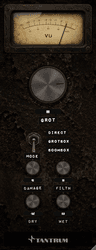
GROT doesn't have a mix knob. It has two independent output faders, one for the untouched input and one for the processed signal, summed at the output.
Why two faders instead of one
A single mix control forces the two paths to trade against each other: more wet always means less dry. Two faders let you do things a blend can't.
- Full insert. DRY at -inf, WET at 0.0. This is the default.
- Parallel. DRY at 0.0, WET wherever it sits best. The dry signal keeps its full level and you add wreckage underneath it, rather than replacing part of your track with it.
- Wet only, quieter. DRY at -inf, WET at -6.0, when GROT is feeding something else downstream.
- Off. Both at -inf. Silence, which is occasionally what an automation lane wants.
The controls
Both read in decibels from -inf to 0.0, where -inf means fully muted and 0.0 means unity gain. Neither can boost: this is a blend stage, not a gain stage. If you need more level out of GROT, use the GAIN control in the hidden panel (see Chapter 10) or trim after the plug-in.
The scale is skewed so the useful part of the range (the top 12 dB or so, where most blending decisions actually happen) occupies the middle of the knob's travel rather than being crushed against the top.
Defaults are DRY -inf and WET 0.0.
Phase
The dry path is tapped from the input before any processing and the wet path carries no net delay, so the two are sample-aligned and sum cleanly. The driver slap adds a delayed layer but does not shift the through-signal, so there's nothing to time-align and nothing to cancel.
You can safely use GROT in parallel without a delay-compensation problem, and the plug-in reports zero latency to your host.
Level, and the automatic level match
Between the processing and the output faders there are two stages you don't have controls for.
The level match. A slow trim (about 250 ms) nudges the wet path's energy back toward the input's, so moving DAMAGE and GROT changes the sound rather than the volume. It's deliberately sluggish, a level match rather than a compressor, and it's bounded to a 0.25× to 2.5× range.
Above about 60% DAMAGE this deliberately lets go and stops tracking, because the terminal-failure stage sustains long after the note that caused it has decayed. Matching it to a decaying dry signal would re-impose the note envelope and make the most extreme setting sound cleaner than the middle of the knob. A fixed compensation curve takes over instead, so the top of the knob stays relentless without becoming silly loud.
The limiter. A soft-knee limiter bounds the wet path before the faders. It catches peaks. It is not a mastering limiter and it isn't intended to be.
The limiter is on the wet path only. The DRY + WET sum is not limited, so with both faders high and GROT and DAMAGE pushed, the output can exceed 0 dBFS. Put a limiter or a trim after GROT if you're driving it hard in parallel.
For parallel colour, start DRY at 0.0 and WET at -inf, then bring WET up until you hear the change and back it off a decibel. Coming up from silence gets you a better answer than starting at unity and pulling down.


