



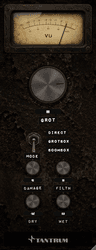
DAMAGE and GROT are things you did to the speaker. FILTH is what happened to it while nobody was looking: a noise floor it can't get rid of, contacts that have corroded, and a signal path that has quietly lost resolution. It's the only control that adds something that wasn't in your signal.
Three layers
Grime
A continuous low-mid noise, band-limited to 150 Hz – 3.5 kHz with a honk around 1 kHz, then saturated for grit and tamed back down. It's modelled on the noise floor of an unmaintained console or a PA that's been in service far too long: dirty rather than hissy.
Grime is keyed to signal presence. It opens as soon as audio is flowing (over roughly 80 ms) and closes quickly in silence (tens of milliseconds once the signal has gone), with a slight level-dependent wobble so it isn't static. It is deliberately not a peak gate: it doesn't duck on transients and it doesn't pump.
Crackle
Sparse impulses with a fast decay tail: loose connections, dried-out contacts, a jack that needs cleaning. The rate rises with the FILTH setting and the timing is genuinely random, so it never falls into a pattern.
Corruption
A gentle, continuous loss of resolution. Bit depth is reduced smoothly from around 12-bit down to roughly 6- or 7-bit equivalent at maximum, then blended back at 25% strength. The result is a grainy, slightly compressed texture rather than the obvious stepping of a bitcrusher.
How the knob behaves
FILTH's response is quadratic: the bottom half of the travel barely does anything, and almost all of the effect lives in the top half. That's deliberate: it makes low settings usable as a texture rather than a commitment.
| Position | What you get |
|---|---|
| 0–30 | A faint layer under the signal; you'd miss it if you weren't listening |
| 30–60 | Audible grime, occasional crackle, a slight grain on the top |
| 60–100 | A gnarly, obvious noise floor that becomes part of the sound |
Living with the noise
FILTH is additive. At high settings with a quiet source it will be audible in the gaps between notes. That's the intended behaviour, because a filthy speaker hisses even when nothing is playing. If you need silence between phrases, automate FILTH down, or gate after GROT.
Because the grime is keyed to presence rather than level, it will not track a performance dynamically. It's either on with the signal or off in silence.
FILTH is the fastest way to make a too-clean digital source sound like it came off something physical, and it works with DAMAGE at zero. Try DIRECT mode, DAMAGE 0, GROT 0, FILTH 50 on a synth or a sampled instrument that sounds too new.


