



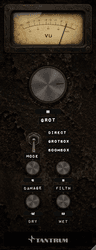

Every automatable parameter, with the name your host shows, the range, and the default.
Front panel
| Panel label | Host name | Range | Default | Reads as |
|---|---|---|---|---|
| MODE | Mode | DIRECT / GROTBOX / BOOMBOX | GROTBOX | the position name |
| GROT | Anger | 0 – 100 | 0 | 0–100 |
| DAMAGE | Damage | 0 – 100 | 0 | 0–100 |
| FILTH | Filth | 0 – 100 | 0 | 0–100 |
| DRY | Dry | −inf – 0.0 dB | −inf | dB, -inf at the floor |
| WET | Wet | −inf – 0.0 dB | 0.0 | dB, -inf at the floor |
The GROT knob is called Anger in your host's automation and parameter lists. It's the same control: the panel label is the product name, the parameter name is the internal one. If you're looking for GROT in an automation menu and can't find it, that's why.
Notes on the ranges
DRY and WET run from −60 dB to 0 dB. The bottom of the range is treated as -inf, fully muted, not −60 dB. Neither can boost above unity. The scale is skewed around −12 dB so the range you actually blend in occupies the middle of the knob's travel.
THRESH is skewed around −24 dB for the same reason.
DAMAGE, GROT and FILTH are stored as 0–1 internally and displayed as 0–100. Their audible response is not linear in that number. See the individual chapters for what happens where.
Smoothing
Every continuous control is smoothed, so automation and fast knob moves don't click or zipper at any buffer size. MODE and SC Mode are discrete and change instantly.
Cross-parameter behaviour
Some controls change what others do. These are deliberate.
| When you change | It also affects | How |
|---|---|---|
| GROT ↑ | DAMAGE | Pushes effective damage further than the DAMAGE knob shows |
| MODE → BOOMBOX | DAMAGE | Breakup is harder |
| MODE → GROTBOX | GROT | Most strain; DIRECT gives the least, BOOMBOX sits between |
| MODE → GROTBOX | DAMAGE | Driver slap high, tight and loud |
| MODE → BOOMBOX | DAMAGE | Driver slap deep and slow |
| DAMAGE ↑ | MODE | The cabinet rings louder and longer |
| DAMAGE > ~60 | Level match | Gradually lets go, so the top of the knob isn't ducked |
| Sidechain engaged | DAMAGE, GROT, FILTH | All three ride between 0 and their set positions |
GAIN and TILT are not affected by the sidechain. DAMAGE does not feed FILTH: cone breakup is signal-related, while grime and crackle belong to neglect alone.
Saved state
Everything above is saved with your session, along with the window size. Settings are stored by parameter name, so sessions move safely between GROT versions and between formats.
This manual is licensed to owners of GROT for using the product. It may not be used to build competing software.


